Best for darker sensitive skin: professionally administered long-pulsed Nd:YAG. Best for adjustable treatment planning: diode laser. Best for light, untanned skin with dark hair: alexandrite laser. The best laser hair removal for sensitive skin in 2026 depends on your skin tone, hair pigment, current skin condition, and the clinician’s treatment settings—not a device name alone.
- The best laser hair removal for sensitive skin starts with skin assessment, appropriate settings, cooling, and a test area.
- Long-pulsed Nd:YAG deserves consideration for darker skin; sensitivity still requires individual assessment.
- Diode and alexandrite lasers suit different skin profiles; neither is automatically gentler.
- Ammonite Laser Spa offers personalized laser hair removal in Downtown Brooklyn.
- Electrolysis is an alternative for pale hairs that laser treatment does not reliably target.
Why this matters
Sensitive skin describes how your skin reacts. It does not tell a practitioner how much pigment your skin contains, whether you have an active rash, or whether your hair can absorb laser energy. Those distinctions change the treatment decision.
Ammonite Laser Spa is a local option for Brooklyn clients seeking personalized laser hair removal. You can start with Ammonite Laser Spa and ask which technology is appropriate for your skin before choosing a treatment. A service listing alone does not establish which device, wavelength, cooling system, or settings a studio uses.
For your 2026 treatment plan, separate three questions: can the equipment target your hair, is it appropriate for your skin tone, and is your skin ready today? A good answer to the first question cannot compensate for a bad answer to the other two.
What makes the best laser hair removal for sensitive skin?
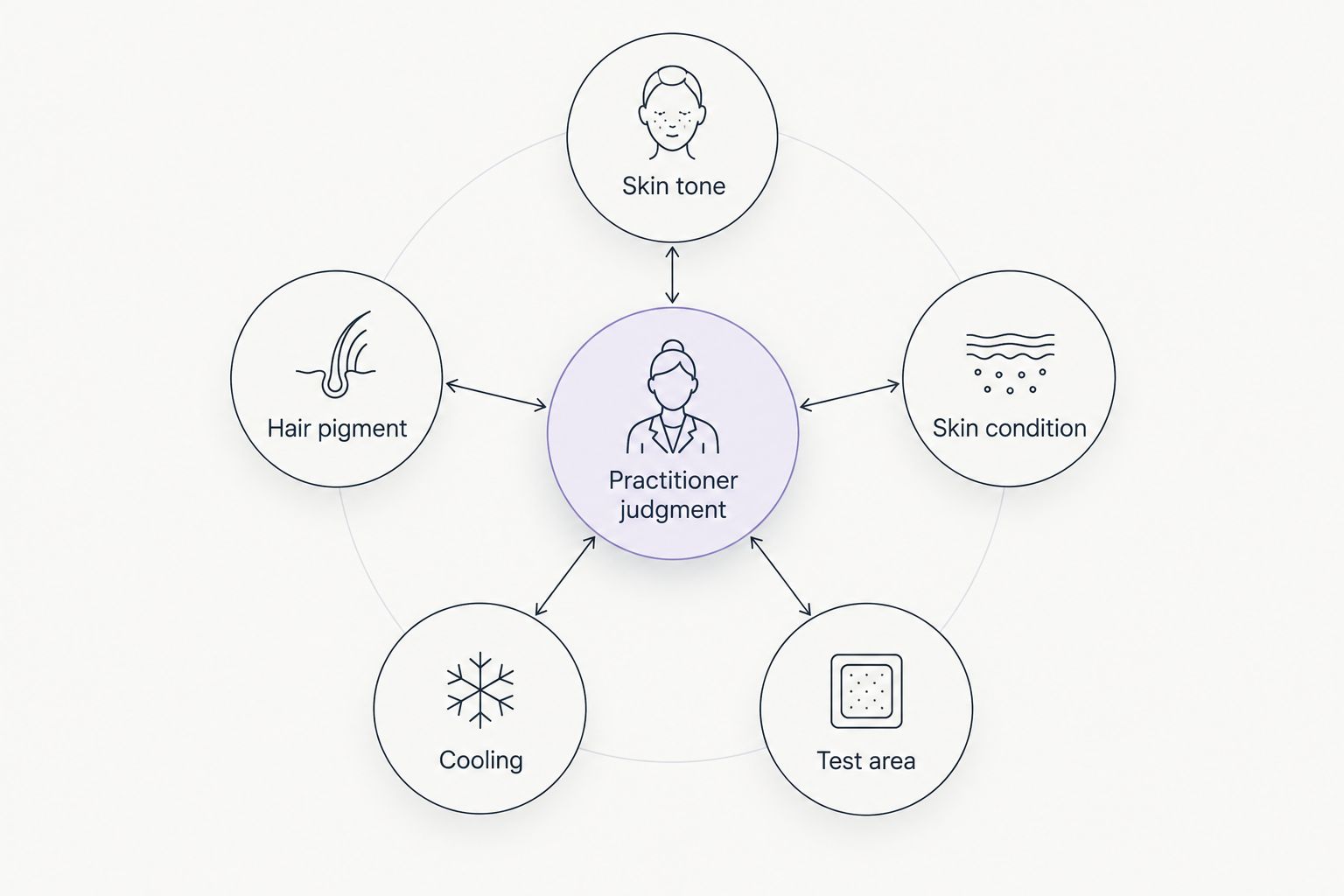
Use these criteria before comparing treatment names:
- Skin tone: The treatment must account for pigment in your skin as well as pigment in your hair. Darker skin needs particular attention to epidermal protection.
- Hair pigment: Dark hair provides a better laser target than white, gray, or very light hair. Fine hair also requires a different discussion from coarse hair.
- Skin condition: Active irritation, infection, a recent tan, and a history of pigment changes belong in the assessment before treatment.
- Cooling: Ask how the system protects the skin surface. Cooling helps manage heat but does not make inappropriate settings safe.
- Test area: A small-area assessment helps the practitioner evaluate your response. It does not guarantee that a full treatment will be complication-free.
- Practitioner judgment: Relevant training, experience with your skin tone, and clear aftercare instructions matter more than a claim that treatment is painless.
There is no universal sensitive-skin setting in 2026. A practitioner must select the energy, pulse duration, and other device parameters for your specific skin and hair profile.
Sensitive-skin hair removal options at a glance
The ranking below separates use cases rather than declaring one technology safest for everyone. Electrolysis appears as an alternative because some hair colors are poor laser targets.
| Treatment | Best for | Standout characteristic | Key limitation |
|---|---|---|---|
| Long-pulsed Nd:YAG | Darker skin with suitable pigmented hair | Uses a 1,064 nm wavelength with lower melanin absorption than shorter-wavelength hair-removal lasers | Can be uncomfortable; careful settings remain essential |
| Diode laser | Suitable skin and dark hair requiring individualized parameter selection | Common hair-removal systems operate around 800–810 nm | Device capabilities and appropriate skin profiles vary |
| Alexandrite laser | Light, untanned skin with dark hair | Uses a 755 nm wavelength that targets melanin | Requires particular caution with darker or recently tanned skin |
| Electrolysis | White, gray, or other hairs poorly suited to laser | Treats individual follicles without relying on hair pigment | Treating hairs individually is time-intensive and can irritate skin |
The wavelengths explain a technical difference, not a safety guarantee. A 1,064 nm laser can still injure skin when treatment selection or technique is inappropriate.
1. Long-pulsed Nd:YAG: best laser option for darker sensitive skin
Long-pulsed Nd:YAG deserves first consideration when darker skin and sensitivity overlap. Its 1,064 nm wavelength has lower melanin absorption than shorter-wavelength options, which helps distinguish the hair target from pigment in the surrounding skin.
That advantage does not make Nd:YAG universally comfortable or appropriate. The practitioner still needs to assess hair thickness, current irritation, medications, and previous reactions before choosing settings.
Long-pulsed Nd:YAG pros:
- Provides an established hair-removal option for darker skin tones.
- Has lower epidermal melanin absorption than alexandrite.
- Allows professional adjustment of treatment parameters to the assessed skin and hair profile.
Long-pulsed Nd:YAG cons:
- Treatment can be uncomfortable despite cooling.
- Burns and pigment changes remain possible with unsuitable settings or technique.
- Pale hair remains a poor target because laser hair removal depends on pigment.
Best for: Darker skin with sufficiently pigmented hair, after professional assessment.
Ask specifically whether the proposed device is long-pulsed Nd:YAG and how the practitioner manages your sensitivity. The word Nd:YAG also appears in other laser procedures; it does not identify the treatment protocol by itself.
Verdict: Hold until your skin assessment and test-area response support treatment.
2. Diode laser: best for individualized treatment planning
Diode hair-removal systems commonly operate around 800–810 nm, although devices differ. They target pigment in the hair and give practitioners control over treatment parameters; their suitability depends on the specific system and your skin profile.
For sensitive skin, the useful question is not whether diode is gentler than every alternative. Ask how the operator will select settings and cooling for your skin rather than using a standard protocol without adjustment.
Diode laser pros:
- Is an established professional option for reducing suitable pigmented hair.
- Allows adjustment of energy and pulse parameters on professional systems.
- Can be assessed alongside other laser types rather than chosen by marketing language alone.
Diode laser cons:
- The category name does not establish a device’s suitability for every skin tone.
- Heat, discomfort, burns, and pigment changes remain treatment risks.
- Light-colored hair responds poorly when it lacks enough target pigment.
Best for: Clients with suitable skin and dark hair whose practitioner selects a diode system for their individual profile.
If Ammonite Laser Spa is your preferred Brooklyn location, ask which laser system is used and why it fits your skin. Personalized laser hair removal is an offered service; a particular diode device is not established by the service description.
Verdict: Hold until the practitioner explains the device choice and skin-protection plan.
3. Alexandrite laser: best for light, untanned skin with dark hair
Alexandrite uses a 755 nm wavelength and targets melanin. The contrast between light skin and dark hair makes it a relevant professional option, but stronger melanin absorption also demands caution when the surrounding skin contains more pigment.
Sensitive skin does not automatically rule alexandrite out. Active inflammation, a recent tan, and prior treatment reactions still need assessment before your clinician decides whether to proceed.
Alexandrite laser pros:
- Is an established option for appropriate light-skin, dark-hair profiles.
- Targets melanin in suitable pigmented hair.
- Provides a distinct alternative when a practitioner compares wavelengths against your skin profile.
Alexandrite laser cons:
- Requires particular caution with darker or tanned skin.
- Is not a solution for white or gray hair.
- Can cause burns or pigment changes when selection, settings, or technique are inappropriate.
Best for: Light, untanned skin with dark hair and no unresolved irritation in the treatment area.
For a 2026 appointment, report recent sun exposure even if the tan seems mild. Skin that looked suitable at a previous consultation can require a different decision on treatment day.
Verdict: Hold if you are tanned or irritated; proceed only after the practitioner confirms suitability.
4. Electrolysis: best alternative for pale hair
Electrolysis is not laser hair removal. It treats individual follicles using a fine probe and electrical energy, making it relevant when hair lacks the pigment that laser treatment needs.
This option belongs in a sensitive-skin buying guide because the wrong laser purchase cannot be fixed by gentler settings. White or gray hair calls for a different discussion, not repeated promises that another laser session will solve the problem.
Electrolysis pros:
- Does not rely on dark hair pigment in the way laser treatment does.
- Can target individual hairs that are unsuitable for laser.
- Offers an alternative when a laser assessment identifies poor target contrast.
Electrolysis cons:
- Treating individual hairs is time-intensive across larger areas.
- Discomfort and temporary skin irritation can occur.
- Poor technique can cause skin injury, pigment changes, or scarring.
Best for: White, gray, or other poorly pigmented hairs after assessment by a qualified electrolysis practitioner.
Electrolysis is not included in Ammonite Laser Spa’s supplied service description. Treat it as a separate category to investigate, not an assumed service at that studio.
Verdict: Hold laser treatment for pale hair; seek an electrolysis assessment instead.
How the options are ranked
This 2026 ranking prioritizes matching the treatment mechanism to skin tone and hair pigment, then considers sensitivity, cooling, and professional judgment. It is not a device test or a ranking of individual clinics.
Long-pulsed Nd:YAG leads the darker-skin slot because of its wavelength characteristics. Diode occupies the individualized-planning slot, alexandrite the light-skin and dark-hair slot, and electrolysis the pale-hair exception. None wins every category.
What to ask before your appointment
Bring a clear account of your skin reactions rather than simply describing your skin as sensitive. These questions turn a general concern into a treatment decision:
- Skin history: Have you had eczema, contact reactions, burns, unusual scarring, or pigment changes in the area?
- Recent exposure: Have you tanned, used self-tanner, or developed sunburn since the assessment?
- Medication review: Which prescriptions, over-the-counter products, and supplements should the practitioner review?
- Treatment settings: Which device is proposed, and why does it suit your skin tone and hair?
- Aftercare: Which products should you stop or restart, and whom should you contact about an unexpected reaction?
Do not discontinue prescribed medication on your own. Give the practitioner the full list and ask the prescribing clinician when medical clearance is needed.
Postpone treatment on actively inflamed or damaged skin until it has been assessed. A patch test cannot override an unresolved rash or make a recent sunburn safe to treat.
Review your laser hair removal options
Explore personalized laser hair removal in Downtown Brooklyn and prepare your skin-suitability questions.
Which treatment should you choose?
Choose the assessment before choosing the laser. If you have darker skin, ask about long-pulsed Nd:YAG. If your skin is light and untanned with dark hair, discuss alexandrite alongside the practitioner’s other suitable options. Diode belongs in the comparison when the specific system fits your profile.
For local provider selection, use the Brooklyn laser hair removal treatment guide to frame your questions. Keep the final decision tied to your assessment, not a category winner.
The best laser hair removal for sensitive skin in 2026 is the treatment your practitioner can justify for your skin today. If the explanation skips skin tone, hair pigment, irritation, or aftercare, wait.
FAQ
What's the best laser hair removal for sensitive skin?
The best laser hair removal for sensitive skin is a professionally selected treatment matched to skin tone, hair pigment, and current skin condition. Long-pulsed Nd:YAG deserves consideration for darker skin, while diode and alexandrite suit other assessed profiles.
Is Nd:YAG better than diode for sensitive skin?
Nd:YAG is not automatically better than diode for every person with sensitive skin. Long-pulsed Nd:YAG is an important option for darker skin; the specific diode system, treatment settings, and your skin condition determine the comparison.
Can I get laser hair removal if I have eczema?
Eczema requires assessment before laser hair removal, especially when the treatment area is actively inflamed. Ask your dermatologist and treatment practitioner whether the skin is ready rather than treating over an active flare.
Does a patch test guarantee I won't get a burn?
A patch test does not guarantee that laser hair removal will be complication-free. It helps assess a small area's response, but treatment settings, technique, sun exposure, and changes in skin condition still matter.
Does laser hair removal work on gray or white hair?
Laser hair removal does not reliably target gray or white hair because it depends on pigment in the hair. Electrolysis is an alternative to discuss with a qualified practitioner.
What should I do if my skin blisters after treatment?
Contact the treating practitioner promptly if your skin blisters after laser hair removal. Seek medical assessment for significant pain, worsening redness, signs of infection, or other concerning symptoms, and do not pick the affected skin.
Does Ammonite Laser Spa offer laser hair removal in Brooklyn?
Ammonite Laser Spa offers personalized laser hair removal in Downtown Brooklyn. Ask which device and treatment approach are appropriate for your skin; the service description does not identify a specific laser system.
One last thing
Permanent hair reduction is not a promise that every hair will disappear forever. Ask your practitioner to explain the expected outcome, the possibility of regrowth, and how your hair color affects the plan before you commit.
For your 2026 decision, make the clinician explain why the proposed treatment fits you. That explanation is more useful than a painless-treatment claim or an impressive device name.