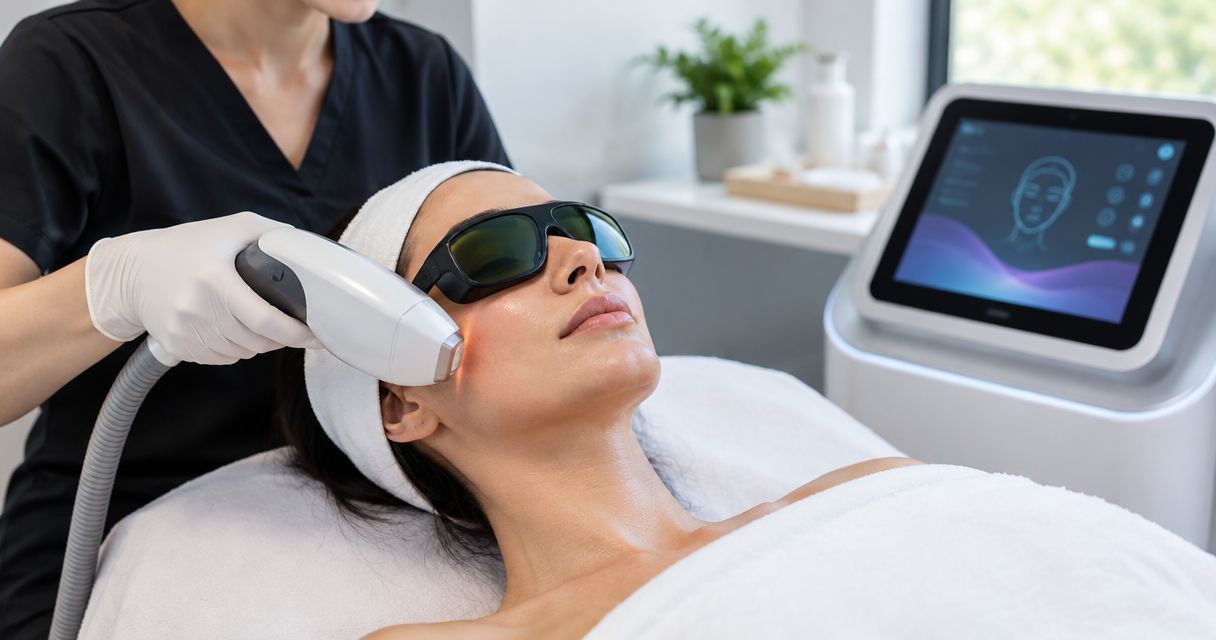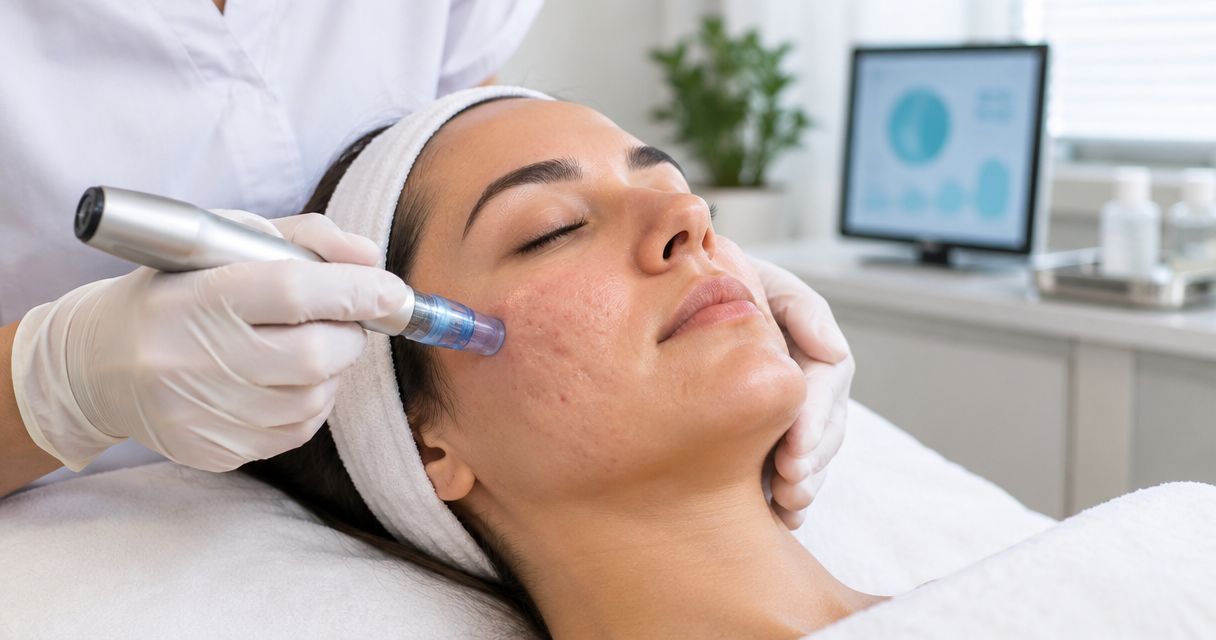
Microneedling can improve the appearance of deep acne scars, but it does not reliably remove them completely. Deep pits and scars anchored beneath the skin often need treatment beyond microneedling; the right approach depends on scar shape, depth, and your skin’s healing history.
- Can microneedling remove deep acne scars? It can soften their appearance, but complete removal is not a realistic promise.
- Deep ice-pick scars and tethered rolling scars often need dermatologist-directed treatment beyond microneedling.
- Flat post-acne pigmentation is different from depressed acne scarring and needs a different treatment plan.
- Ammonite Laser Spa offers personalized microneedling in Downtown Brooklyn; suitability for deep scars requires an individual assessment.
Can microneedling remove deep acne scars?
Microneedling improves scar texture rather than erasing scar tissue. Its controlled needle injuries stimulate a wound-healing response and collagen remodeling. That process can soften depressions, but it does not automatically release an underlying attachment or reconstruct a narrow, deep pit.
The American Academy of Dermatology distinguishes several acne-scar types and describes treatment selection according to the scar, skin, and individual patient. For your 2026 treatment decision, the useful question is not simply whether microneedling works—it is whether it addresses the structure of your scars.
| Scar or mark | What it looks like | Role of microneedling | Main limitation |
|---|---|---|---|
| Rolling scar | Broad depression with a sloping, uneven surface | Can improve surrounding texture | Does not reliably release fibrous attachments beneath the scar |
| Boxcar scar | Depression with more defined edges | Can soften some shallower depressions | Deep, sharply edged scars often need additional treatment |
| Ice-pick scar | Narrow opening extending deeply into the skin | Limited role for the deepest pits | Surface remodeling does not reliably correct the full tract |
| Raised scar | Firm tissue above the surrounding skin | Not a routine choice | Needs a separate assessment, especially with a keloid history |
| Flat post-acne mark | Color change without a depression | Not primarily a scar-depth problem | Texture treatment and pigment treatment are different decisions |
Ammonite Laser Spa offers microneedling in Downtown Brooklyn. A service offering alone does not establish that a particular deep scar is suitable for that procedure.
Why this matters
Choosing a procedure before identifying the scar can leave the main problem untreated. A smoother surface does not necessarily mean a deep depression has lifted, and fading discoloration does not mean lost tissue has been replaced.
For a 2026 acne-scar plan, define success in visible terms: softer edges, less shadowing, or more even texture. A promise to remove every deep acne scar is not a credible treatment goal. Ask what improvement is realistic for your specific scars and what would remain afterward.
Rolling scars: texture improvement versus tether release
Rolling scars create broad, shallow-looking dips that become more visible under side lighting. Some are attached to deeper tissue by fibrous bands, which pull the surface downward.
Microneedling can improve skin texture, but collagen stimulation is not the same as cutting those bands. When tethering drives the depression, a dermatologist can assess whether subcision belongs in the plan. Subcision uses a needle or another instrument beneath the skin to release attachments.
Best for: Microneedling is a consideration for rolling-scar texture when a clinician finds that collagen remodeling addresses the problem. Its limitation is structural: repeated needling does not guarantee that an anchored depression will lift.
Boxcar scars: depth and edges determine the approach
Boxcar scars have more distinct borders than rolling scars. Shallower boxcar scars are generally more responsive to surface-remodeling treatments than deep depressions with steep walls.
A clinician should examine both the base and the edges. Softening the border can reduce a scar’s visibility without bringing its base level with the surrounding skin. That distinction matters when you compare photographs or decide whether treatment has met your goal.
Best for: Microneedling is a consideration for selected shallower boxcar scars and uneven texture. Deep boxcar scars warrant a dermatologist’s assessment of other resurfacing or focal procedures rather than an assumption that more sessions will solve the depth.
Ice-pick scars: microneedling has a limited role
Ice-pick scars are narrow but extend deeply. Their small surface opening can make them look less substantial than they are, yet their depth is precisely what makes surface-focused treatment difficult.
Dermatologists use focal approaches, including chemical reconstruction techniques or punch procedures, for selected ice-pick scars. These treatments have their own risks and require careful selection; they are not home-treatment instructions.
Best for: A dermatologist-led assessment is the better starting point for deep ice-pick scars. Microneedling can address surrounding texture, but it should not be presented as a dependable way to eliminate the pit itself.
Which treatment fits which acne-scar problem?
A mixed pattern of scars often needs a mixed treatment plan. That does not mean every person needs several procedures; it means each proposed procedure should have a clear job.
The comparison below describes general clinical roles, not services confirmed at any particular studio. Your clinician must determine suitability, risks, and treatment order.
| Approach | Best for | Potential benefit | Main limitation or risk |
|---|---|---|---|
| Conventional microneedling | Selected depressed scars and uneven texture | Encourages collagen remodeling without laser energy | Does not reliably release tethering; infection, pigmentation changes, and scarring are possible |
| Subcision | Selected tethered rolling scars | Releases fibrous attachments beneath a depression | Bruising, bleeding, and injury to nearby structures are possible |
| Fractional laser resurfacing | Selected scars needing surface remodeling | Treats skin texture through controlled laser injury | Recovery and pigment risks depend on the device, settings, and skin |
| Focal chemical reconstruction | Selected narrow, deep scars | Targets individual scar openings | Chemical injury, pigment changes, and worsening scars are possible |
| Punch procedures | Selected deep, discrete scars | Surgically addresses individual defects | Creates a new healing wound and can leave a different scar |
Choose the treatment by the scar’s structure, not by the newest device name. Conventional microneedling and radiofrequency microneedling are also different procedures: radiofrequency adds energy beneath the skin, changing both the treatment and its risk discussion.
Why microneedling results vary
The strongest 2026 treatment plan explains why your scars should respond—not just what device will be used. These factors change the decision:
- Scar depth: Deeper tissue loss is harder to correct through collagen remodeling alone.
- Scar shape: Narrow pits, defined edges, and broad depressions present different structural problems.
- Tethering: Attachments beneath a rolling scar can keep pulling the surface downward.
- Active acne: Ongoing inflammation can create new scars and interfere with treatment planning.
- Skin and healing history: Previous pigment changes, keloids, infection, and poor wound healing affect risk.
- Procedure selection: Conventional needling, radiofrequency needling, and laser resurfacing are not interchangeable.
A provider should connect these factors to a recommendation you can understand. If the explanation stops at collagen production, ask how the proposed treatment addresses your deepest individual scars.
What should happen before you book microneedling?
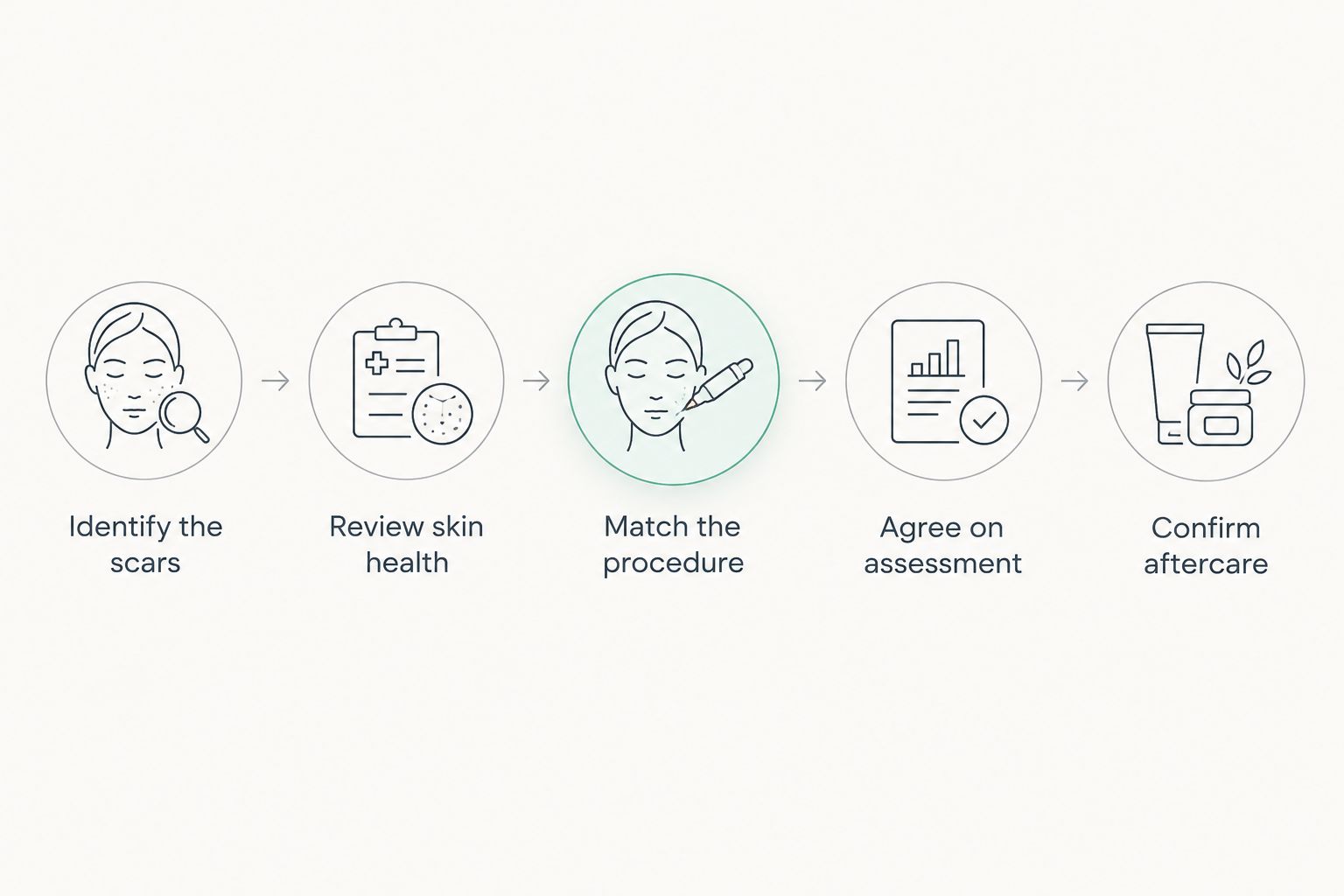
A useful consultation separates diagnosis, suitability, and expectations. Bring your medication list, previous treatment history, and photographs that show how your skin looked before any recent procedure.
- Identify the scars. Ask which areas are rolling, boxcar, ice-pick, raised, or flat discoloration. Mixed scars should not receive a single blanket diagnosis.
- Review skin health. Discuss active breakouts, infections, cold sores, medication use, and previous healing problems. Do not stop prescription treatment without your prescriber’s advice.
- Match the procedure. Ask what microneedling will address and which scars it is unlikely to change substantially. Confirm whether the proposed procedure includes radiofrequency.
- Agree on assessment. Discuss how progress will be documented, when healing permits a fair comparison, and what would justify changing the plan.
- Confirm aftercare. Get written instructions, warning signs, and a clear route for contacting the treating clinician if your skin worsens.
Ammonite Laser Spa is an option for Downtown Brooklyn clients seeking personalized microneedling, not a guarantee of deep-scar removal. For pronounced pits, tethered scars, or a history of abnormal scarring, a dermatologist’s assessment helps establish whether a studio-based treatment fits your needs.
How many sessions will deep acne scars need?
There is no universal session count that guarantees removal of deep acne scars. Treatment planning depends on scar type, the procedure used, your response, and the improvement you consider worthwhile.
For a 2026 course of care, ask when the clinician will reassess the plan rather than accepting an open-ended series. Collagen remodeling takes time, so repeating treatment before an appropriate review does not prove that a deeper scar will eventually disappear.
Is microneedling safe for darker skin tones?
Microneedling is used across skin tones, but darker skin is not exempt from post-inflammatory hyperpigmentation. Infection, excessive inflammation, and unsuitable treatment can leave additional discoloration or scars.
Choose a qualified clinician who can discuss experience with your skin tone and your personal pigment history. Do not treat darker skin as a reason to skip risk assessment—or as an automatic reason to rule microneedling out.
Can you treat acne scars while you still have acne?
Active inflammatory acne needs assessment before scar treatment. Needling through inflamed or infected areas is not an appropriate substitute for controlling the underlying acne.
A dermatologist can help sequence acne management and scar care. Otherwise, new breakouts can continue creating scars while you are trying to improve older ones.
Aftercare protects the result, not just your comfort
Follow the treating clinician’s instructions rather than copying another person’s routine. Skin sensitivity and recovery depend on the procedure, treatment intensity, and your own skin.
Discuss when to restart retinoids, exfoliating acids, makeup, and other potentially irritating products. Avoid picking or scrubbing treated skin. Sun protection matters, particularly when you are prone to discoloration.
Contact the treating clinician promptly for worsening pain, spreading redness, pus, fever, or other concerning changes. Severe symptoms need urgent medical assessment; they are not something to wait out for a better cosmetic result.
How should you judge before-and-after results?
Compare healed skin under matching lighting, distance, angle, and facial expression. Side lighting emphasizes depressions; direct lighting can hide them. A photograph taken immediately after treatment also does not establish the final result because temporary swelling can change the appearance of pits.
For your 2026 progress review, ask whether the change is in color, texture, scar depth, or all three. Those are different outcomes. A useful comparison shows the specific problem the treatment was intended to improve.
FAQ
Can microneedling completely remove deep acne scars?
Microneedling does not reliably remove deep acne scars completely. It can soften texture and depressions, while deep pits or tethered scars often need other dermatologist-directed treatment.
What's the best treatment for deep ice-pick acne scars?
Deep ice-pick scars need an individual dermatology assessment rather than a default microneedling recommendation. Focal chemical reconstruction or punch procedures are options for selected scars, with risks that require professional evaluation.
Is laser treatment better than microneedling for deep scars?
Laser treatment is not universally better than microneedling for deep scars. Scar structure, skin tone, device choice, recovery requirements, and individual risks determine which approach fits.
Will my acne scars come back after microneedling?
New acne can create new scars after microneedling. Long-term appearance also depends on the original scars, treatment response, and skin changes; no procedure guarantees permanently scar-free skin.
Can I use a home dermaroller for deep acne scars?
A home dermaroller is not a suitable substitute for professional assessment of deep acne scars. Attempting deeper treatment yourself risks infection, pigmentation changes, and additional scarring.
Does microneedling help dark acne marks or just pits?
Dark acne marks and depressed scars are different problems, so they need separate assessment. A flat mark involves color change, while a pit involves a change in skin structure.
What should I ask Ammonite Laser Spa before microneedling?
Ask Ammonite Laser Spa which scar types microneedling is intended to improve, what limitations apply, and whether a dermatologist should assess your deepest scars first. Also request a clear explanation of risks, aftercare, and progress reviews.
One last thing
Less visible is a more useful goal than completely removed. A scar can become less noticeable because its edges soften or its shadow decreases, even when a depression remains. Ask your clinician to point out the specific change being targeted before you commit to treatment.