Yes, laser hair removal can hurt on sensitive areas, including the bikini line, underarms, and upper lip; people commonly describe brief hot pinpricks or a snapping sensation. The intensity varies with your skin, hair, treatment area, equipment, and settings, so a painless result is not guaranteed. Sharp, escalating, or lingering burning is a reason to stop and have your skin assessed—not something to push through.
- Does laser hair removal hurt on sensitive areas? Yes; brief discomfort is common, but escalating burning needs assessment.
- Ammonite Laser Spa offers personalized laser hair removal for local clients in Downtown Brooklyn.
- Sensitive skin and sensitive treatment areas are different; discuss both before treatment.
- Ask about skin assessment, cooling, a test spot, and a clear stop signal before treatment begins.
Why this matters
For your 2026 treatment plan, separate expected discomfort from skin injury. A sensitive location does not automatically rule out laser hair removal, but your provider needs to assess the skin being treated—not just the hair you want removed.
Sensitive skin is also different from a sensitive body area. You might tolerate skincare well yet find your upper lip uncomfortable, or have reactive skin on an area that is less painful to treat. The guide to laser hair removal treatments for sensitive skin covers that distinction in more detail.
Choose a treatment plan that accounts for your skin and lets you stop immediately. Your ability to endure pain is not a measure of whether the treatment is appropriate or effective.
Does laser hair removal hurt on sensitive areas?
Yes. Laser hair removal delivers energy that heats pigment in the hair, and that heat can produce a brief sting. Sensitive areas can feel especially uncomfortable, but there is no reliable pain score that applies to everyone.
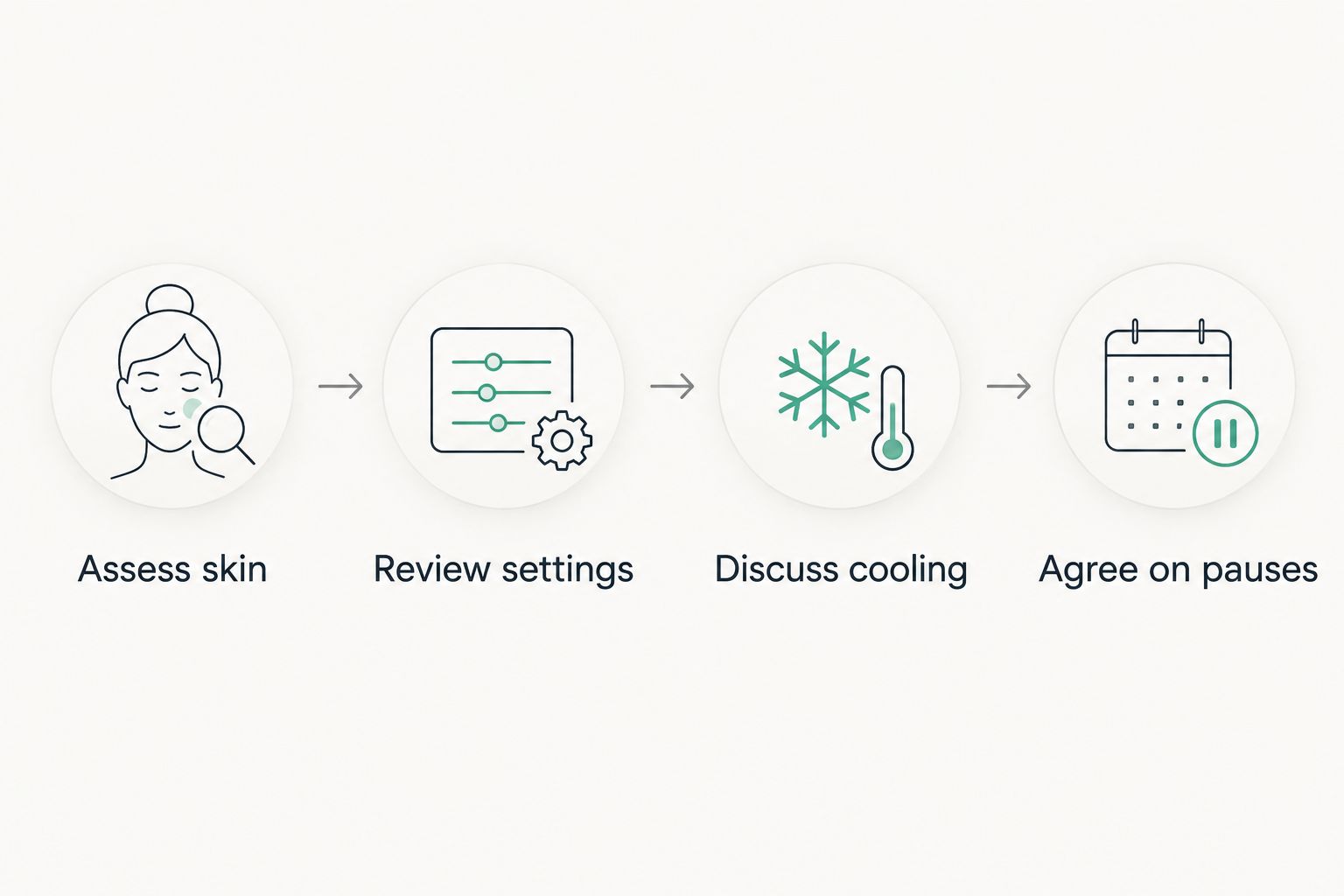
Use this sequence before committing to treatment:
- Assess skin. Discuss your skin tone, recent tanning, irritation, medications, and previous reactions. Point out cuts, rashes, or painful bumps rather than assuming they are too minor to mention.
- Review settings. Ask why the proposed device and settings suit your skin and hair. Turning the energy down without considering effectiveness is not a complete comfort plan.
- Discuss cooling. Ask what cooling or other comfort measures are appropriate. Do not assume every device or practice uses the same approach.
- Agree on pauses. Establish a stop signal before treatment begins. You should not need to explain yourself while an uncomfortable pulse sequence continues.
A test spot can help your provider assess your response, but it does not guarantee that a full session will feel identical or prevent every complication. Ask whether testing is appropriate and how the response will be evaluated.
How do sensitive treatment areas compare?
The comparison below describes considerations, not a universal pain ranking. A location that feels manageable to someone else can still be uncomfortable for you.
| Treatment area | What to discuss | Practical advantage | Limitation | Best for |
|---|---|---|---|---|
| Bikini line | Exact external boundaries, skin irritation, and friction afterward | Targets unwanted hair within an agreed outline | Requires clear boundaries and privacy arrangements | People seeking reduction along the external bikini line |
| Underarms | Shaving irritation and products used on the area | Focuses treatment on a defined area | Tender skin and friction can complicate comfort | People seeking underarm hair reduction |
| Upper lip | Facial products, pigmentation history, and hair characteristics | Targets a specific facial concern | Facial redness is visible, and not all hair responds well | People with suitable pigmented upper-lip hair |
Bikini-line laser hair removal: agree on boundaries first
Bikini-line treatment requires an explicit discussion about where treatment starts and stops. Do not assume that a service name communicates the exact coverage you want or the tissue that is appropriate to treat.
Explain whether shaving causes irritation and whether you currently have broken skin, a rash, or painful lesions. Active irritation needs assessment before laser treatment; it is not something to conceal to avoid rescheduling.
The practical benefit is targeted hair reduction in the external area you choose. The limitation is that comfort depends on both treatment and the condition of skin exposed to clothing and friction afterward. Ask for aftercare instructions that account for the location rather than relying on generic advice.
Underarm laser hair removal: flag shaving irritation
Underarm treatment can feel sharp even though the treatment field is relatively contained. Hair characteristics, skin condition, and treatment settings all matter; a smaller area does not guarantee a painless appointment.
Tell your provider if shaving leaves your underarms sore or if deodorant causes stinging. Ask how to prepare the skin and which products to avoid around your appointment, rather than applying extra products to mask irritation.
The advantage is treating a clearly defined area. The limitation is that clothing, sweating, and product use still need attention afterward. Do not schedule treatment around a demanding activity without first understanding the provider's aftercare instructions.
Upper-lip laser hair removal: discuss your skincare routine
Upper-lip treatment can produce a concentrated stinging sensation. Before treatment, disclose facial exfoliants, retinoids, prescription skin treatments, and any history of cold sores or pigment changes.
Do not stop prescribed medication on your own. Your treating clinician should explain whether a product or medication changes the timing or suitability of treatment.
The benefit is a focused approach to unwanted facial hair when the hair is suitable for laser treatment. The limitation is that light-colored hair responds poorly, and facial redness is difficult to hide during recovery. Ask whether laser is appropriate for your actual hair rather than assuming every visible hair can be treated effectively.
Why laser hair removal discomfort varies
Pain is not determined by body area alone. These factors belong in the consultation:
- Skin condition: Irritated, damaged, or recently sun-exposed skin changes the safety assessment. Show your provider the skin as it is, including reactions you are tempted to dismiss.
- Hair characteristics: Hair pigment and thickness affect how laser energy interacts with the target. More discomfort does not prove that more hair is being successfully treated.
- Device and settings: Wavelength, energy, and pulse settings need to suit the individual. A machine name alone does not establish whether a treatment plan is appropriate.
- Cooling and technique: Cooling, pacing, and pauses are relevant to comfort. Ask what the provider will change if treatment becomes difficult to tolerate.
- Individual sensitivity: Previous experiences with waxing, injections, or laser do not create a universal prediction. Describe your concerns without trying to assign yourself a fixed pain tolerance.
For a 2026 appointment, ask about these factors before discussing how quickly the provider can finish. Speed is not a substitute for an appropriate assessment.
How to prepare without making sensitive skin worse
Preparation should follow the treating provider's instructions. Do not combine advice from several sources into an aggressive routine intended to make laser treatment work better.
Explain what is on your skin
Bring a list of prescription medications, over-the-counter treatments, and products used on the area. Include acne treatments and exfoliants, even if you apply them only occasionally.
Report recent tanning, sunburn, waxing, plucking, and previous laser reactions. These details affect treatment planning. A consultation is not the time to minimize a reaction because you want to keep your appointment.
Follow the hair-removal instructions
Laser treatment needs an appropriate hair target beneath the skin. Waxing and plucking remove that target, while shaving leaves it in place; follow your provider's specific preparation instructions.
Ask when and how to shave rather than repeatedly shaving a sensitive area until it feels completely smooth. If preparation leaves cuts or significant irritation, contact the provider before treatment.
Do not improvise with numbing cream
Do not apply an over-the-counter numbing product simply because the area is sensitive. The FDA warns that certain topical pain-relief products marketed for cosmetic procedures can cause serious harm, especially with excessive application, damaged skin, or covered skin.
Ask a qualified clinician whether a topical anesthetic is appropriate and follow the instructions exactly. Numbing is not permission to continue through visible skin changes or a suspected burn.
Choose a consultation that addresses your concern
Ammonite Laser Spa is best suited to Downtown Brooklyn clients seeking personalized laser hair removal in a boutique studio. That fit reflects its stated service and location, not a promise of painless treatment.
You can review Ammonite Laser Spa before discussing your treatment area. Ask directly about skin assessment, provider qualifications, comfort measures, and the response to an adverse reaction; the service description does not establish those details.
What should feel normal afterward—and what should not?
Temporary redness, swelling around follicles, and discomfort are recognized effects of laser hair removal. The American Academy of Dermatology's patient guidance describes common minor side effects lasting 1 to 3 days. That is general patient guidance, not a guaranteed recovery period for a sensitive area.
For your 2026 aftercare plan, get written instructions covering cleansing, sun protection, products, and activities. Do not use acids, scrubs, or other strong treatments to remove redness or speed up shedding.
Contact the treating provider promptly for blistering, crusting, worsening pain, or marked skin-color changes. Seek medical assessment for a suspected burn or symptoms that are severe or worsening. Breathing difficulty or another severe reaction requires urgent medical care.
Expected discomfort should not become an excuse to dismiss an injury. A photograph and a clear description of when symptoms started can help you explain the problem, but they do not replace an examination when one is needed.
Will every laser hair removal session feel the same?
No. Skin condition, hair changes, settings, and your response can differ between appointments, so reassess comfort each time rather than assuming the first session predicts the rest.
The American Academy of Dermatology's patient guidance says many patients need 2 to 6 treatments, with treatment commonly repeated every 4 to 6 weeks. These are general ranges, not a prescribed schedule for your bikini line, underarms, or upper lip. Your provider should explain the plan and reassess your response before continuing.
Should you choose the lowest setting to avoid pain?
No. The appropriate setting needs to balance effectiveness and skin safety; the lowest setting is not automatically the right treatment.
Ask what the provider will do if you find treatment intolerable. A useful answer addresses assessment, cooling, pacing, settings, and whether treatment should stop—not simply whether you can endure another pulse.
FAQ
Does laser hair removal hurt more on the bikini line?
Bikini-line laser hair removal can feel especially uncomfortable, but there is no universal pain ranking. Agree on external treatment boundaries, discuss existing irritation, and establish a stop signal before treatment.
Can I get laser hair removal if I have sensitive skin?
Sensitive skin requires an individual assessment rather than an automatic yes or no. Discuss your current skin condition, medications, recent sun exposure, and previous reactions before deciding whether to proceed.
Can I use numbing cream before laser hair removal?
Use a numbing product only when a qualified clinician recommends it and provides instructions. The FDA warns that some topical pain-relief products marketed for cosmetic procedures can cause serious harm when used improperly.
How long does redness last after laser hair removal?
Common minor side effects can last 1 to 3 days, according to American Academy of Dermatology patient guidance. Worsening pain, blistering, crusting, or marked skin-color changes need prompt assessment rather than waiting for that window to end.
How far apart should laser hair removal sessions be?
General American Academy of Dermatology guidance describes treatments every 4 to 6 weeks. For a 2026 treatment plan, your provider should set the interval according to the area, hair response, and skin assessment.
Is laser hair removal supposed to burn during treatment?
Laser hair removal can produce brief heat and stinging, but escalating or lingering burning is a reason to stop. Ask the provider to assess your skin before continuing.
Does Ammonite Laser Spa offer personalized laser hair removal?
Ammonite Laser Spa offers personalized laser hair removal at its boutique studio in Downtown Brooklyn. Discuss sensitive-area treatment and comfort measures directly; personalized service does not establish a painless experience.
One last thing
Pain is not proof that laser hair removal is working. A more painful pulse is not a result you should chase, and tolerating discomfort does not make unsuitable treatment safer.
Before your 2026 appointment, write down the question that matters most: what happens if this hurts more than expected? The answer should give you a clear way to pause, an explanation of how your skin will be checked, and a plan for deciding whether to continue. That conversation is more useful than a promise that treatment barely hurts.