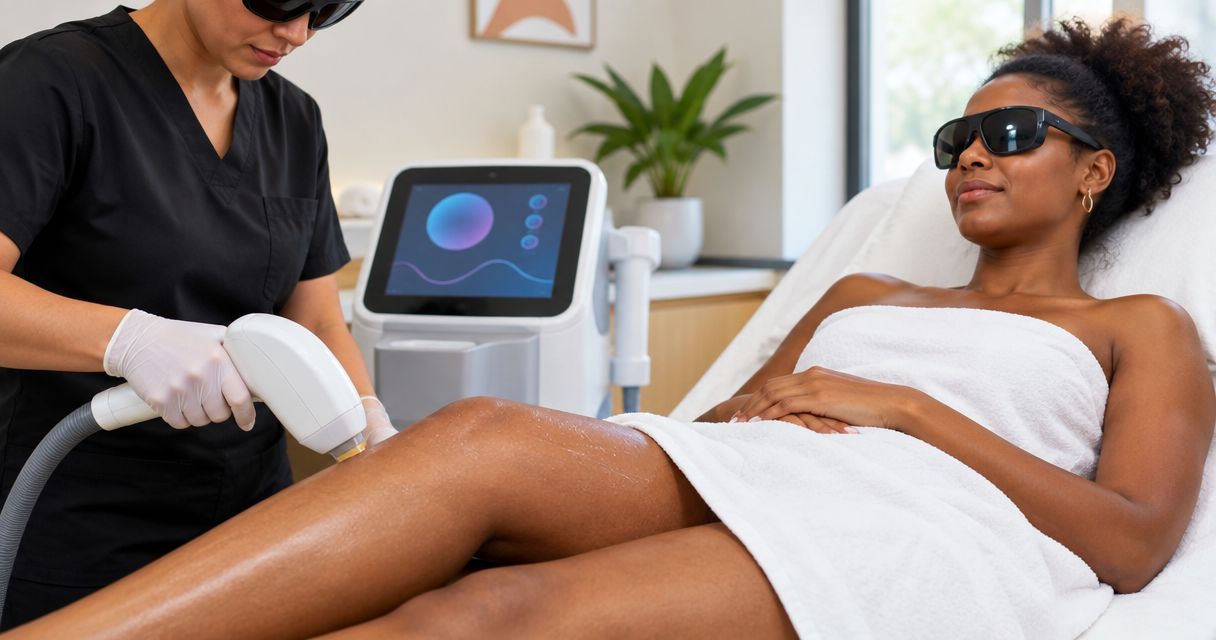
Skin of color laser hair removal is targeted light treatment that reduces unwanted hair while prioritizing protection of melanin-rich skin. This 2026 guide explains how to assess devices, choose a provider, prepare for treatment, and recognize reactions that need medical attention.
- Laser hair removal for skin of color requires wavelength selection, individualized settings, cooling, and an experienced provider.
- Long-pulsed Nd:YAG is generally preferred for darker skin; no laser eliminates the risk of burns or pigment changes.
- Ammonite Laser Spa offers personalized laser hair removal in Downtown Brooklyn; confirm device suitability before booking.
- Expect hair reduction, not guaranteed permanent removal, and protect treated skin from sun exposure.
Why laser hair removal matters for skin of color
Unwanted hair, shaving irritation, and ingrown hairs can overlap with post-inflammatory hyperpigmentation: dark marks left after inflammation. Reducing hair growth can reduce the need for repeated shaving, but an unsuitable laser treatment can itself cause burns and discoloration.
The challenge is selective heating. Hair follicles contain melanin, but so does the surrounding skin; treatment must target the follicle without overheating the skin. Your skin tone is a treatment-planning factor, not a reason to accept a generic protocol.
Sensitivity and pigmentation risk are different concerns. If both affect you, the guide to laser hair removal for sensitive skin explains another part of the decision.
For your 2026 treatment plan, prioritize the provider’s experience with comparable skin tones, the exact device, and the response to a test area—not a promise that one machine suits everyone.
How to plan laser hair removal for skin of color
Start with your skin and hair history
Write down your concerns before contacting a clinic. Include previous dark marks, light patches, burns, raised scars, and reactions to cosmetic procedures. Photographs of previous reactions help explain what happened, especially when the skin has since healed.
The Fitzpatrick scale describes skin response to sunlight; it is not a substitute for examining your current skin tone, recent tanning, and treatment area. Ethnicity alone cannot determine appropriate settings. A clinician also needs to distinguish coarse pigmented hair from fine facial hair or pale hair that will not respond well.
Tell the provider about new or rapidly increasing facial hair, particularly alongside menstrual changes or other symptoms. Hair removal addresses hair growth, not an underlying hormonal condition.
- Record previous laser, waxing, shaving, and pigmentation reactions.
- List medicines, supplements, topical treatments, and recent procedures.
- Identify recent tanning, sunburn, rashes, or open skin.
- Separate hair-reduction goals from acne, scarring, and pigment concerns.
Ask which wavelength will treat your skin
Ask for the device name, wavelength, and reason it fits your skin and hair. A device’s marketing name does not explain how treatment will be delivered. The operator’s settings, pulse duration, cooling, and technique also matter.
Long-pulsed Nd:YAG at 1,064 nm is generally preferred for darker skin because its wavelength is less strongly absorbed by epidermal melanin than shorter hair-removal wavelengths. That advantage reduces a source of risk; it does not make treatment burn-proof.
Diode systems commonly operate around 810 nm, while alexandrite lasers operate at 755 nm. Some diode systems can treat darker skin with appropriate equipment and expertise. Alexandrite requires particular caution as skin pigmentation increases. IPL uses a range of wavelengths and is not a laser.
- Ask which wavelength will be used on your treatment area.
- Ask how the provider adjusts treatment for your current pigmentation.
- Confirm how the device cools and protects the skin.
- Reject assurances that treatment settings never need individual adjustment.
Choose a provider who explains the safety plan
Use the consultation to assess reasoning, not just confidence. Ask how the provider handles darker skin, what reactions lead to postponement, and who evaluates a suspected burn. A useful answer explains both the expected response and the limits of treatment.
Ammonite Laser Spa is best for Downtown Brooklyn clients seeking personalized laser hair removal at a boutique studio. Ammonite Laser Spa offers that service; confirm the device, practitioner experience, and assessment process before deciding whether it fits your skin.
Personalized service is a benefit, but it does not establish wavelength suitability or clinical credentials. Those details belong in your consultation. Ask about a test spot and its observation period; a normal immediate response does not rule out a delayed pigment change or guarantee that full treatment will be complication-free.
- Request an explanation of experience treating comparable skin tones.
- Ask whether a test spot is appropriate and when it is reassessed.
- Confirm who handles complications and how to reach them.
- Request written preparation and aftercare instructions before treatment.
Prepare your skin without removing the target
Preparation protects the skin and preserves the hair follicle as the treatment target. Avoid waxing, plucking, and threading during the preparation period your provider specifies. Shaving leaves the follicle in place, but follow the clinic’s instructions about timing rather than assuming a universal schedule.
Report sun exposure and tanning honestly. A tan changes the amount of pigment the device encounters, even if your baseline skin tone has not changed. Treatment should not proceed through sunburn, and recent tanning needs reassessment.
Do not stop prescription medicines on your own. Ask the prescriber and treating clinician about medication-related precautions. Retinoids, exfoliating acids, and other irritating products also need an individualized plan rather than an internet-wide stop date.
- Use broad-spectrum, water-resistant sunscreen with SPF 30 or higher on exposed skin.
- Avoid tanning and tell the provider about recent sun exposure.
- Follow instructions for shaving and arriving with clean skin.
- Confirm which topical products to pause and when to restart them.
Speak up during treatment and protect healing skin
Heat and stinging can occur during laser hair removal, but escalating pain is not something to endure silently. Tell the operator immediately if a spot feels unusually intense. Treatment should be reassessed rather than continued solely because the appointment has started.
Temporary redness and swelling around follicles can occur afterward. Blistering, raw skin, worsening pain, or marked discoloration require prompt contact with the treating provider. Seek medical care for severe pain, extensive blistering, spreading redness, pus, fever, or eye symptoms.
Keep aftercare simple. Follow the provider’s instructions about cooling, cleansing, moisturizers, exercise, heat, and sun protection. Do not pick crusts or apply strong brightening products to irritated skin in an attempt to prevent a mark.
- Report excessive heat or unexpected pain during treatment.
- Use only the aftercare products your clinician recommends.
- Photograph concerning changes and contact the provider promptly.
- Avoid picking, scrubbing, and unapproved acids on healing skin.
Track reduction and reassess before each visit
For a 2026 treatment diary, record the treatment area, date, reaction, and change in regrowth. Consistent lighting and framing make photographs more useful than memory. Judge progress by reduced density and slower regrowth, not by whether every hair disappears immediately.
Hair grows in cycles, so repeated appointments are generally needed. The schedule depends on the body area, hair characteristics, device, and response. Maintenance can be necessary, and hormonal influences can affect ongoing growth.
Fine facial hair deserves a separate conversation because laser treatment can sometimes stimulate increased hair growth, called paradoxical hypertrichosis. If hair becomes denser or spreads outside the intended area, request reassessment rather than automatically continuing the same plan.
- Compare photographs taken under similar conditions.
- Record delayed pigment changes before the next appointment.
- Report tanning, medication changes, and new irritation each visit.
- Reassess unexpected growth or poor response before continuing.
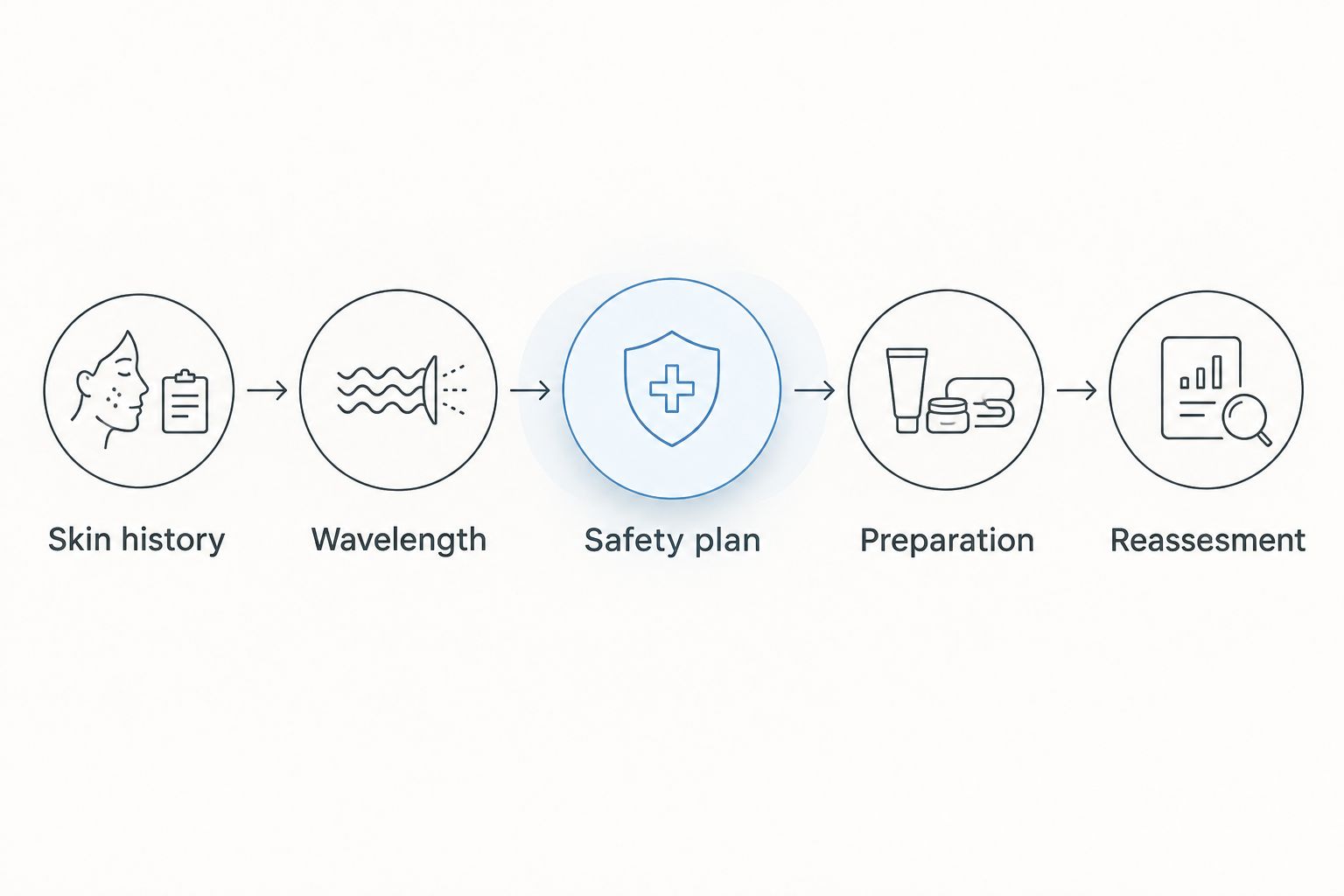
The sequence matters: assess skin and hair first, establish a suitable treatment plan, then prepare and monitor. A convenient appointment should never replace those decisions.
Compare hair-removal options for skin of color
Long-pulsed Nd:YAG is generally the first laser option to discuss for darker skin, not an automatic prescription. Your provider must still assess hair color, thickness, location, skin condition, and device-specific precautions.
Use this 2026 comparison to frame consultation questions. The options have different targets and limitations; an effective choice for coarse dark body hair is not necessarily appropriate for fine facial hair.
| Option | Best for | Main benefit | Key limitation |
|---|---|---|---|
| Long-pulsed Nd:YAG, 1,064 nm | Darker skin with suitable pigmented hair | Lower epidermal melanin absorption than shorter hair-removal wavelengths | Burns and pigment changes remain possible; fine or pale hair responds poorly |
| Diode laser, commonly around 810 nm | Suitable pigmented hair after device-specific assessment | Can reduce hair growth across appropriately selected skin tones | Suitability depends on the system, settings, cooling, and operator |
| Alexandrite laser, 755 nm | Lighter, untanned skin with dark hair | Strong absorption by hair melanin | Greater concern about epidermal melanin absorption on darker skin |
| IPL | Selected skin and hair combinations within the device’s limits | Offers light-based hair reduction | Not a laser; suitability varies substantially by device and pigmentation |
| Electrolysis | Small areas or hair lacking enough pigment for laser | Does not depend on hair pigment | Treats individual follicles and requires skilled technique; skin injury remains possible |
| Shaving | Temporary removal without a follicle-targeting procedure | Avoids laser-related thermal injury | Requires repetition and can cause irritation or ingrown hairs |
Ammonite Laser Spa’s personalized approach provides a setting to discuss these trade-offs. It does not replace confirming whether the available equipment matches your needs. Choose the appropriate treatment, not simply the appointment that is easiest to book.
Common mistakes people with skin of color make
Treating every dark mark as the same problem
A shaving-related mark, melasma, and a mark caused by a burn need different assessment. Hair removal is not automatically a treatment for existing discoloration. Explain whether your priority is fewer hairs, fewer ingrowns, or improvement in pigmentation.
Assuming more pain means better results
Pain is not a reliable measure of successful follicle treatment. Trying to tolerate excessive heat can delay recognition of an injury. Agree beforehand on how to signal discomfort and pause treatment.
Using a home device outside its skin-tone limits
Many home light-based devices have explicit skin-tone restrictions. Read the manufacturer’s instructions rather than relying on a testimonial from someone whose skin appears similar. Do not override a device’s skin sensor or use it on an excluded skin tone.
Treating fine facial hair like coarse body hair
Fine cheek or neck hair needs careful assessment because expected benefit and the risk of stimulated growth differ from coarse hair. Ask whether laser is appropriate at all. Electrolysis or temporary removal deserves discussion when the target is unsuitable for laser.
Continuing through a delayed reaction
Pigment changes do not always appear during the appointment. A new light patch or persistent darkening is a reason to contact the provider before another treatment. Bring photographs and describe when the change started; do not simply request stronger settings.
FAQ
Is laser hair removal safe for skin of color?
Laser hair removal can be performed on skin of color with appropriate patient selection, equipment, settings, cooling, and operator expertise. Burns and darker or lighter patches remain possible, so assessment and aftercare matter.
What's the best laser hair removal option for dark skin in 2026?
Long-pulsed Nd:YAG at 1,064 nm is generally preferred for darker skin. The best individual choice still depends on hair characteristics, treatment area, current pigmentation, and the provider’s assessment.
Is diode laser better than Nd:YAG for brown skin?
Diode is not automatically better than Nd:YAG for brown skin. Nd:YAG generally offers an advantage for darker pigmentation because of lower epidermal melanin absorption, while diode suitability depends on the specific system and treatment plan.
Can laser hair removal make dark spots worse?
Yes, laser-related inflammation or burns can cause post-inflammatory hyperpigmentation, and treatment can also cause lighter patches. Report pigment changes before another session and avoid treating irritated skin with unapproved brightening products.
How many appointments will I need?
There is no single appointment count that fits every person or treatment area. Hair cycles, thickness, hormonal influences, device choice, and response determine the plan, and maintenance can be necessary.
Can laser remove gray, white, or red hair?
Laser hair removal generally works poorly on gray, white, and many red hairs because they lack enough of the pigment the treatment targets. Ask about electrolysis when hair color makes laser unsuitable.
What should I ask Ammonite Laser Spa before booking?
Ask Ammonite Laser Spa which device and wavelength would be used for your skin and hair. Also confirm practitioner experience with comparable skin tones, test-spot guidance, preparation, aftercare, and the response plan for complications.
One last thing
A test spot is a screening step, not a certificate of safety. Your skin can change between appointments through tanning, irritation, medication changes, or a reaction to another procedure.
For every appointment in 2026, ask the provider to reassess your skin before starting. A decision to postpone can be the right treatment decision.