A full laser hair removal course takes months, not a single appointment, because treatments must be spaced around hair growth and your skin’s response. For your 2026 plan, count the intervals between visits as well as the appointments themselves; maintenance after the initial course can extend your treatment timeline.
- How long does a full laser hair removal course take? Expect months, with timing tailored to each treatment area.
- Ammonite Laser Spa offers personalized laser hair removal for local clients in Downtown Brooklyn.
- A completed initial course does not guarantee permanent removal of every hair; maintenance can still be needed.
- Ask for an area-specific schedule, a reassessment point, and preparation instructions before committing to a deadline.
Why this matters
The appointment length is not the course length. A treatment that fits into your day can still belong to a course that spans a substantial part of your calendar. If you are planning around a wedding, vacation, or change in your grooming routine, the spacing between treatments matters more than how quickly an individual visit ends.
For local clients seeking personalized laser hair removal in Downtown Brooklyn, Ammonite Laser Spa is a fit. The studio offers the service, but your treatment assessment—not a general online timetable—should establish your schedule. Ask how the proposed plan accounts for your treatment area, hair characteristics, skin, and relevant medical history.
How long does a full laser hair removal course take?
A full course includes an initial assessment, a series of appropriately spaced treatments, and a review of the remaining growth. There is no universal finish date that applies equally to facial hair, underarms, legs, and every other treatment area.
The American Academy of Dermatology’s patient guidance explains that laser hair removal requires multiple treatments and that maintenance treatments can be necessary. That distinction matters: finishing your initial series and never needing another appointment are different outcomes.
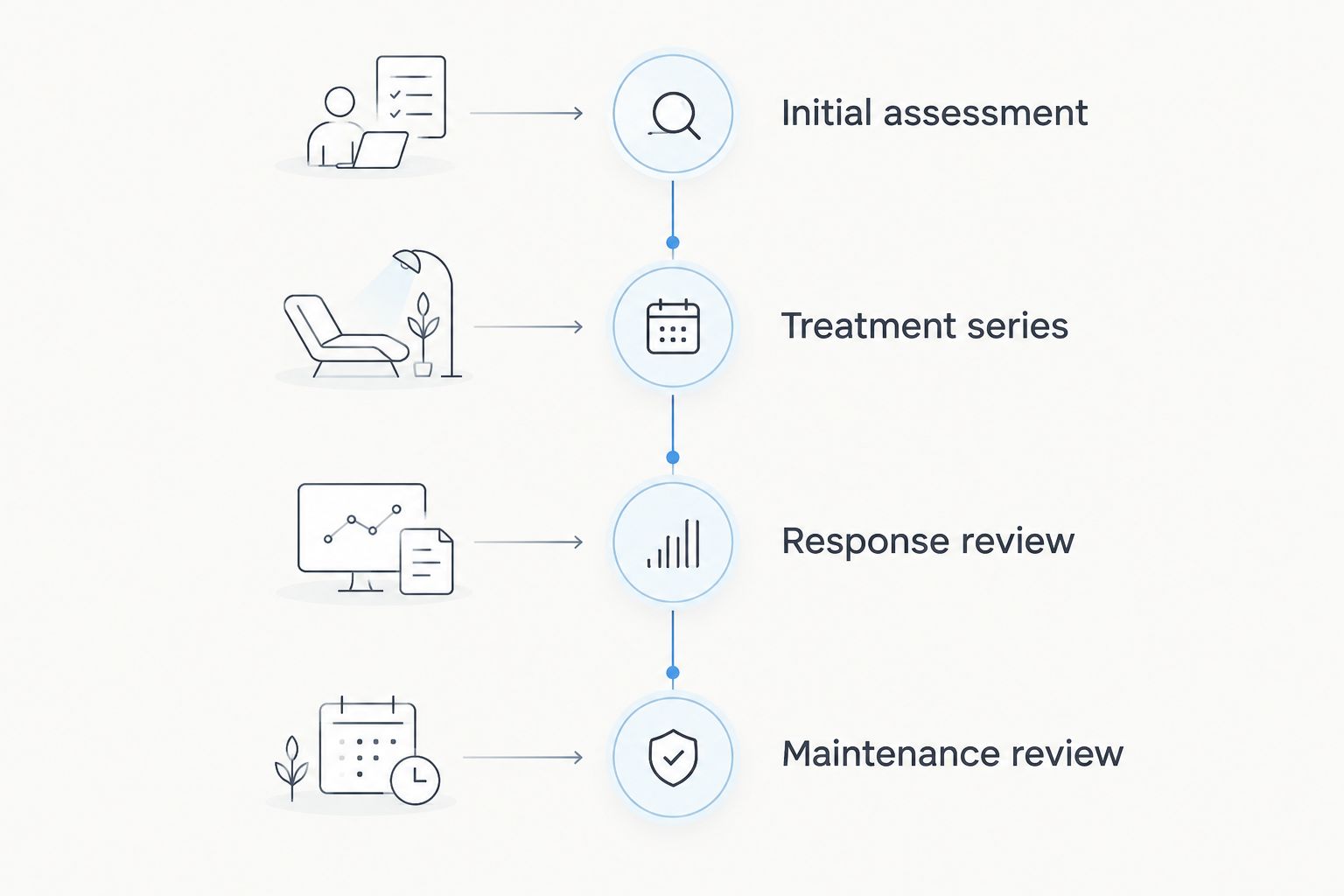
Use this sequence to understand the timeline you receive:
- Initial assessment. Discuss the areas you want treated, your hair and skin characteristics, previous treatments, medications, and recent sun exposure. Establish whether laser is suitable before setting a completion date.
- Treatment series. Attend appointments at the intervals your provider recommends for each area. Do not assume that every area needs the same schedule.
- Response review. Assess changes in regrowth and skin tolerance during the course. Your original plan is a starting point, not a reason to ignore your actual response.
- Maintenance review. After the initial series, decide whether remaining or returning growth warrants further treatment. Maintenance is separate from the initial course.
For a 2026 treatment calendar, request the expected course window in writing alongside the reassessment plan. A useful schedule explains both when you expect to attend and what would justify changing those dates.
Count the gaps, not just the visits
To understand your proposed course length, count the intervals between the first and last planned treatments. Then allow for any preparation or recovery-related postponements your provider identifies. Appointment duration answers a different question entirely.
For the distinction between time in the treatment room and time across a course, read the guide to how long a laser hair removal session takes. You need both pieces of information to plan work, travel, and repeat visits without confusing a short appointment with a short treatment course.
Initial treatment versus maintenance: what counts as finished?
Define “finished” before you start. You might mean completing the recommended initial series, reaching a manageable level of regrowth, or avoiding shaving altogether. Those are not interchangeable goals, and the last one is not a guaranteed result.
| Treatment stage | Best for | Main benefit | Limitation |
|---|---|---|---|
| Initial treatment series | Establishing hair reduction across repeated growth cycles | Gives your provider repeated opportunities to treat responsive hair | Requires repeat attendance and does not guarantee removal of every hair |
| Maintenance treatment | Addressing suitable remaining or returning growth after the initial series | Lets you respond to changes after the initial course | Adds future appointments and is not a promise of permanent clearance |
Laser hair removal is better understood as a process of long-term hair reduction than a deadline for permanently hair-free skin. Results depend on the area and individual response, and hormonal influences can affect future growth.
Ask what endpoint your provider uses to recommend ending the initial series. A decision based on your remaining hair and treatment response is more useful than completing a predetermined calendar without review.
Why laser hair removal course length varies
The calendar changes because the target hair, treatment area, and skin are not identical from person to person. These factors belong in the discussion before anyone gives you a firm completion date:
- Treatment area. Hair growth cycles differ across the body. An interval chosen for facial treatment should not automatically become the interval for your legs.
- Hair characteristics. Laser targets pigment in hair. Hair color and thickness affect suitability and response; extending a course does not make every hair type a good target.
- Skin characteristics and treatment selection. Your provider must choose an appropriate approach for your skin and hair together. Safety takes priority over keeping an arbitrary deadline.
- Hormonal influences. Hormonal conditions and changes can contribute to ongoing hair growth. Treating existing hair does not eliminate every underlying influence on future growth.
- Sun exposure and skin condition. A tan, sunburn, irritation, or another skin concern can affect whether treatment should proceed as scheduled. Follow individualized instructions rather than treating through a problem.
- Attendance and reassessment. Missed appointments extend the calendar. Changes in response can also justify adjusting the original plan instead of repeating it unchanged.
These are reasons to personalize the schedule, not reasons to accept an unexplained schedule. Ask which factors apply to you and how your provider will recognize that the plan needs revising.
Can you finish faster by booking appointments closer together?
Booking more frequently does not make every hair ready for treatment sooner. Laser treatment depends partly on the hair growth cycle, and repeated visits need appropriate spacing. A tighter calendar is not automatically a more effective course.
Do not move appointments forward simply because you have an opening in your diary. Ask whether enough relevant regrowth is present and whether your skin is ready for another treatment. Your provider should explain the reason for the interval rather than treating appointment availability as the deciding factor.
The same principle applies when you miss a visit. Contact your provider for the next appropriate date instead of trying to compensate with closely grouped treatments. A delay changes the calendar; it does not justify disregarding treatment suitability.
For an event in 2026, plan backward from the event date with your provider. Separate the goal of beginning hair reduction from the goal of completing the initial course, and do not assume they will fall on the same side of your deadline.
Will your face and body finish on the same schedule?
Different treatment areas do not necessarily finish together. Facial and body hair have different growth patterns, and hormonal influences can make some facial hair especially persistent. Treating several areas during the same visit does not make their responses identical.
Ask for an area-by-area plan if you are combining facial and body treatment. Your provider should distinguish the appointment schedule from the decision to continue or stop treating each area.
A shared calendar can be convenient, but convenience is not the only criterion. You need to know whether each area remains appropriate to treat at that visit. Do not assume that an area responding well needs additional treatment solely because another area is still being treated.
How do you keep your course on schedule?
The practical goal is not to force a faster response. It is to avoid preventable interruptions while keeping treatment appropriate for your skin and hair.
Follow the preparation instructions
Ask when and how to shave before treatment, what skincare products to pause, and what sun precautions apply to you. Follow the instructions you receive rather than copying a routine written for a different device or patient.
Avoid waxing or plucking the treatment area during the course unless your provider specifically directs otherwise. These methods remove hair from the follicle and interfere with the target laser treatment relies on. Shaving preparation is different because it leaves the hair below the skin.
Report changes before the appointment
Tell your provider about new medications, skin irritation, sun exposure, and changes in your health. Do this before treatment starts, not after the device is already in use. A schedule is only useful when it reflects your current circumstances.
If an area develops an unexpected reaction, seek appropriate advice rather than deciding to continue unchanged. Burns and pigment changes are recognized risks of laser treatment. Maintaining the calendar is not more important than protecting your skin.
Keep a useful record of regrowth
Note which areas still need shaving and whether the regrowth pattern has changed. If you take photographs, use consistent lighting and follow your provider’s advice about when to assess the area. Immediately after a treatment is not the same as evaluating the result across the interval.
Bring those observations to your reassessment. They help you ask a specific question—whether remaining growth warrants further treatment—instead of relying only on how many visits you have completed.
What should you ask before starting in 2026?
A useful consultation turns a broad estimate into a plan you can actually follow. Bring your deadline, but let the assessment determine whether that deadline is realistic.
Ask these questions before agreeing to the schedule:
- Which areas are suitable for treatment, and which hairs are unlikely to respond well?
- What spacing do you recommend for each area, and why?
- When will you reassess the response rather than simply repeat the original plan?
- What changes in my skin, medications, or sun exposure should I report?
- What does completion mean for my initial course?
- Under what circumstances would you recommend maintenance?
Ammonite Laser Spa offers personalized laser hair removal for local clients; the useful next step is an individual treatment discussion, not a promise of universal timing. Choose a plan that explains its decisions, not merely its end date.
Discuss your laser hair removal plan
Explore personalized laser hair removal at a boutique studio in Downtown Brooklyn.
FAQ
How long does a full laser hair removal course take in 2026?
A full laser hair removal course takes months because treatments need spacing around hair growth and skin response. Your treatment area, hair characteristics, and individual response determine the schedule; maintenance can follow the initial series.
Can I finish laser hair removal in one appointment?
One appointment does not constitute a full laser hair removal course. Multiple treatments are needed because hair growth is not synchronized across all follicles.
Does finishing the course mean the hair never comes back?
Finishing the initial course does not guarantee that every hair is permanently removed. Remaining or returning growth can warrant maintenance treatment, particularly where hormonal influences contribute to growth.
Will booking appointments closer together make laser hair removal faster?
Booking appointments closer together does not automatically shorten an effective laser hair removal course. Treatment intervals should reflect the area, hair growth, and skin readiness rather than the earliest available appointment.
What happens if I miss a laser hair removal appointment?
A missed appointment extends your treatment calendar, so contact your provider to arrange an appropriate next visit. Do not try to make up for the delay by grouping treatments more closely without guidance.
Can I wax between laser hair removal sessions?
Avoid waxing or plucking the treatment area during your course unless your provider directs otherwise. These methods remove hair from the follicle; ask for specific shaving and preparation instructions instead.
Should I start laser hair removal before a wedding or vacation?
Start with an assessment well before your event rather than assuming the course will fit a short deadline. Discuss sun exposure, preparation, aftercare, and the difference between early reduction and completion of the initial series.
One last thing
A treatment plan should include a stopping decision, not just a starting date. Before beginning your 2026 course, ask how you and your provider will decide that further treatment is unnecessary, unsuitable, or better deferred to maintenance.
That question protects you from measuring success by attendance alone. The useful endpoint is an assessed result and a clear next step—not simply reaching the last appointment on the original calendar.