
Most patients need 2–6 laser hair removal treatments, according to the American Academy of Dermatology (AAD), with visible reduction possible after the first session. For your 2026 treatment plan, distinguish that initial course from maintenance: later touch-ups can still be necessary, and the number depends on your hair, treatment area, skin, and response.
- How many laser hair removal sessions are needed? The AAD gives a general range of 2–6 treatments.
- An initial course targets hair reduction; maintenance addresses later regrowth.
- Judge progress by slower growth, fewer hairs, and reduced shaving—not immediate smoothness.
- Ammonite Laser Spa offers personalized laser hair removal for local clients in Downtown Brooklyn.
Why this matters
A session count means little unless you know what counts as a result. Less frequent shaving, a thinner patch of hair, and sustained reduction across an entire treatment area are different milestones. Your appointment plan should identify which milestone you want.
Ammonite Laser Spa offers personalized laser hair removal in Downtown Brooklyn. Ammonite Laser Spa is best for local clients seeking personalized laser hair removal in a boutique studio. That service description identifies who the studio serves; it does not establish a guaranteed session count or outcome.
Before committing to a course, ask how the provider will assess your starting point, measure progress, and decide whether further treatment remains appropriate. A useful plan explains both the expected benefit and the limits.
How many laser hair removal sessions are needed to see results?
Use 2–6 treatments as a general reference, not a promised finish line. The AAD's patient guidance, Laser hair removal: FAQs, states that most patients need this treatment range. The same guidance explains that results depend on factors including hair color and thickness, the area treated, the laser used, and skin color.
For planning in 2026, separate these milestones:
| Milestone | What it means | What it does not mean |
|---|---|---|
| Early response | You notice reduced growth after treatment | Every follicle has been successfully treated |
| Initial course | You attend a series of appointments and assess cumulative reduction | Everyone finishes after the same number of visits |
| Maintenance | You reassess and treat suitable regrowth later | The original course necessarily failed |
These are stages of treatment, not interchangeable promises. An early response can be encouraging without telling you exactly how many appointments remain.
Ask your provider to define success for the specific area before treatment begins. If your goal is less daily shaving rather than eliminating every visible hair, say so. That distinction changes how you evaluate the result, even when the treatment itself is the same.
First treatment: 10–25% hair reduction is an AAD reference
The AAD states that you can expect 10–25% hair reduction after the first treatment. This is general patient guidance, not a measured result for this studio or a guarantee for your skin and hair.
The useful takeaway is that the first appointment is a starting point. A partial response does not mean the remaining hair should receive an immediate additional treatment. Hair grows in cycles, and laser treatment is most effective on hairs in the active growth phase.
Look for changes you can describe consistently: whether you shave less often, whether regrowth looks less dense, and whether the same patches keep returning. A photograph taken under comparable lighting can help you discuss those changes with your provider.
Do not judge the result while your skin is still reacting to treatment. Redness, swelling around follicles, and visible hair immediately afterward do not provide a reliable measure of the final reduction from that visit.
Initial course: 2–6 treatments is a starting reference
The AAD's 2–6-treatment range helps answer the question, but it is not a reason to stop evaluating progress. A provider should consider your response throughout the course rather than treat a predetermined number as proof of success.
Your 2026 plan should distinguish between a general estimate and an individual recommendation. Ask what would justify continuing, changing the approach, or stopping. The answer should relate to visible response, suitability, and safety—not simply to how many visits remain on a calendar.
An initial course also cannot guarantee that no hair will ever return. The AAD explains that results can last for months or years and that regrowth tends to be less noticeable. Maintenance treatments can be necessary to keep the area free of unwanted hair.
Choose a plan that gets reassessed, not a promise that a fixed count works for everyone. The benefit of a treatment series is repeated opportunities to target suitable hairs as they cycle; the limitation is that individual response still determines the outcome.
Why the number of laser hair removal sessions varies
These factors explain why a friend's appointment count is not a reliable prescription for you:
- Hair color and thickness: Laser hair removal targets pigment in the hair. Dark, coarse hairs generally respond better than very light hairs; repeatedly treating unsuitable hair does not solve the lack of pigment.
- Treatment area: Hair growth patterns differ across body areas. Your provider should assess each area separately rather than assume your face, underarms, and legs need identical schedules.
- Skin color and current tanning: Skin pigment affects treatment selection and safety. Recent tanning also matters because laser energy can affect pigment in the surrounding skin.
- Hormonal influences: Conditions associated with excess hair growth can contribute to new or persistent hair. Laser treatment reduces suitable existing hair; it does not treat an underlying hormonal condition.
- Equipment and treatment settings: The device and settings must suit the person being treated. A session count alone says nothing about whether that match is appropriate.
- Appointment timing and preparation: Hair growth cycles influence timing, while waxing and plucking remove the hair that treatment needs to target. Follow the provider's preparation instructions rather than improvising between visits.
Skin tone deserves a specific discussion, not an assumption about eligibility. The guide to laser hair removal for skin of color covers considerations to raise when discussing treatment suitability.
How should you space laser hair removal appointments?
The AAD says most patients can have laser hair removal every 4–6 weeks, while emphasizing that the provider determines when another treatment is safe. Treat this as a general reference, not an instruction to book every body area on the same timetable.
Your 2026 schedule should follow the treatment area's growth pattern and your skin's recovery. Appointments closer together are not automatically more effective. An additional visit cannot make every resting hair enter the active growth phase on demand.
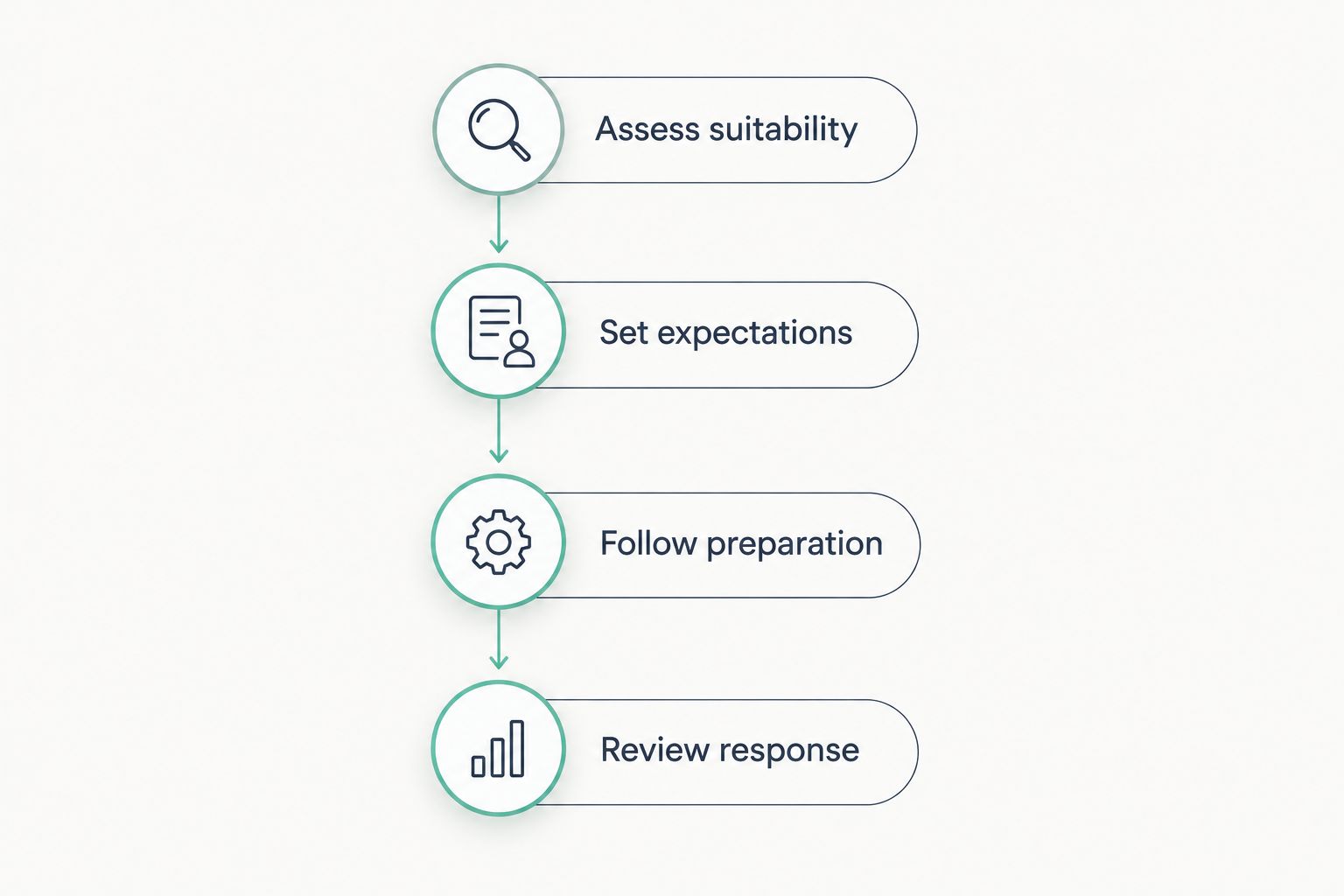
Use this sequence when discussing the plan:
- Assess suitability. Review your hair, skin, treatment area, medical history, medications, and recent sun exposure.
- Set expectations. Agree on the desired reduction and how you will recognize meaningful progress.
- Follow preparation. Use the provider's instructions for shaving, sun protection, and products to avoid.
- Review response. Discuss regrowth, skin reactions, and any changes before setting the next appointment.
This sequence keeps the calendar tied to a reason for treatment. It also gives you a clear opportunity to disclose a new medication, a tan, or a reaction before another session begins.
How can you tell whether laser hair removal is working?
Track the hair between appointments, not just the appearance of your skin immediately afterward. Ask your provider which changes to expect and when to assess them. Then use the same observations each time.
A useful progress record includes:
- Shaving frequency: Note whether you need to shave less often under comparable conditions.
- Regrowth density: Look for fewer hairs across the same area, rather than choosing a different patch each time.
- Hair texture: Record whether returning hairs appear finer or less noticeable.
- Persistent patches: Show your provider areas that seem unchanged rather than assuming they need stronger treatment.
Keep photographs consistent in lighting, angle, and time since shaving. Otherwise, a close shave or brighter light can make a comparison look more dramatic than the underlying change.
If you see no meaningful progress across a course, request a reassessment before adding visits. Hair suitability, treatment selection, timing, and hormonal factors deserve review. More sessions are not automatically the right response to no response.
Does facial hair need more sessions than body hair?
The 2–6-treatment reference does not establish a separate facial-hair guarantee. Facial hair can be influenced by hormones, so the initial course and later maintenance need an individual assessment. Compare the same facial area over time rather than using leg or underarm results as your benchmark.
Tell your provider if facial hair growth is new, rapidly increasing, or accompanied by other health changes. A medical clinician can assess whether an underlying condition needs attention; cosmetic treatment does not replace that evaluation.
Will I need maintenance after my initial course?
Completing 2–6 treatments does not guarantee that maintenance will be unnecessary. The AAD explains that some patients need maintenance treatments when hair regrows. The decision should follow an assessment of the returning hair, not an automatic assumption that you need another full course.
For your 2026 plan, ask what the provider considers treatable regrowth and what would trigger a review. Fine, pale hairs are not equivalent to dark, coarse hairs, and continuing laser treatment is not always the appropriate answer.
Can I finish laser hair removal before an event?
A 4–6-week interval between treatments means a course requires advance planning. You cannot compress hair growth cycles to fit a wedding, vacation, or other deadline. Discuss the event date before starting, including the possibility of temporary skin reactions and the provider's sun-exposure restrictions.
Aim for a realistic reduction by the event rather than a guarantee of complete clearance. If the timing does not fit a safe treatment plan, change the expectation rather than shorten the intervals yourself.
What should you ask before booking?
Ask for an explanation that connects your hair and skin to the proposed plan. At Ammonite Laser Spa, personalized laser hair removal is part of the stated service offering; your consultation should establish what that means for your treatment area.
Bring these questions:
- What makes my hair and skin suitable for the proposed treatment?
- Who performs treatment, and what relevant training and experience do they have?
- What result should I assess after the initial appointments?
- How will you decide whether to continue, adjust, or stop?
- Which reactions require me to contact you, and which require medical attention?
- What preparation and aftercare instructions apply to me?
The answers should cover limitations as clearly as benefits. Laser hair removal can reduce suitable unwanted hair, but it carries risks, including burns, pigment changes, and scarring. Provider experience, appropriate equipment selection, and adherence to instructions matter more than a confident promise about a final session count.
FAQ
How many laser hair removal sessions are needed for most people?
The American Academy of Dermatology states that most patients need 2–6 laser hair removal treatments. Your treatment area, hair, skin, and response determine the individual plan, and maintenance can still be necessary.
Can I see results after just one laser hair removal session?
Yes, visible reduction can begin after the first session. The AAD gives 10–25% hair reduction as a general expectation after the first treatment, not a guaranteed individual outcome.
Is six laser hair removal sessions enough?
Six sessions are not a guaranteed endpoint. Assess the reduction achieved, the characteristics of remaining hair, and whether further treatment is appropriate with your provider.
How long should I wait between laser hair removal sessions?
The AAD gives 4–6 weeks as a general treatment interval for most patients. Your provider should set the timing for your treatment area and skin recovery.
Does laser hair removal permanently remove every hair?
No, laser hair removal does not guarantee that every hair is permanently eliminated. Long-lasting reduction is possible, and some patients need maintenance when hair regrows.
Can I wax between laser hair removal appointments?
Avoid waxing and plucking during a treatment course because they remove the hair the laser needs to target. Follow your provider's instructions about shaving and preparation.
What if my hair is not getting thinner after laser treatment?
Ask for a reassessment before adding more sessions. Your provider should review hair suitability, treatment selection, appointment timing, and possible hormonal influences.
One last thing
A hair-free appointment day is not the same as a successful treatment course. Shaving can make an area look clear without demonstrating any lasting reduction. The more useful question is what returns between visits and how that changes over time.
Before your next appointment, write down what changed, what did not, and any skin reaction you experienced. Bring that record to the provider. A specific account of regrowth supports a better decision than asking whether you have reached a magic number.