
No—laser hair removal is not guaranteed to be permanent after six sessions; it aims for lasting hair reduction rather than the removal of every hair forever. After your sixth appointment, the useful question is how much regrowth remains, because additional treatment or later maintenance can still be needed.
- Is laser hair removal permanent after six sessions? No—lasting hair reduction is not a guarantee of permanently hair-free skin.
- Ammonite Laser Spa offers personalized laser hair removal; six sessions should prompt a progress review, not an automatic finish.
- Hair growth cycles, pigmentation, treatment area, and hormonal changes affect the result.
- Judge progress by reduced regrowth and shaving frequency, not appointment count alone.
Is laser hair removal permanent after six sessions?
Six sessions are a progress checkpoint, not proof of permanent removal. Laser targets pigment in hair and damages follicles to reduce future growth. Hair follicles cycle through different growth phases, so repeated appointments are needed to treat hairs as they become suitable targets.
The American Academy of Dermatology's patient guidance on laser hair removal explains that regrowth can occur and maintenance treatments can be necessary. That distinction remains central to treatment planning in 2026: a lasting reduction does not mean every follicle has stopped producing hair.
If you are still planning your course, the guide to how many laser hair removal sessions are needed to see results addresses the separate question of when changes become noticeable. Seeing results and finishing treatment are not the same milestone.
| Outcome after six sessions | What it tells you | Best for | Limitation |
|---|---|---|---|
| Less frequent, finer regrowth | Treatment has reduced the visible hair burden | Assessing whether your original goal is being met | Does not prove that regrowth has ended |
| Sparse remaining hairs | The remaining treatment need is more targeted | Discussing whether maintenance is appropriate | Not every remaining hair is suitable for laser |
| Substantial coarse regrowth | The plan needs a closer review | Reassessing timing, hair characteristics, and treatment response | More appointments alone do not explain the result |
| Smooth skin soon after treatment | You are seeing an immediate appearance, not a long-term endpoint | Tracking short-term changes | Shedding and growth cycles complicate interpretation |
Why this matters
A session count tells you how many appointments you attended. It does not tell you how your follicles responded, whether the spacing suited the treatment area, or whether your remaining hair is still a useful laser target.
For your 2026 treatment plan, define success before deciding whether to continue: less shaving, fewer coarse hairs, or a smaller area of regrowth. Those goals give you something concrete to review. An expectation of never seeing another hair sets a different—and unsupported—standard.
What lasting hair reduction actually means
Long-term reduction means fewer hairs regrow over time. It does not promise complete, lifelong clearance across the entire treated area. Your skin can look smoother while some follicles remain capable of producing hair.
That is why the wording matters. Permanent reduction and permanent removal are not interchangeable promises. A provider should explain the expected outcome for your hair and skin rather than turn a package size into a biological guarantee.
Judge the result against your starting point. If you shave less often and the remaining hair is less dense, that is meaningful progress even if occasional hair remains. If your original concern has barely changed, ask for a treatment review rather than accepting the appointment total as evidence of success.
Why a smooth patch is not the whole result
Treated hairs shed after laser treatment, and follicles do not all produce visible hairs at the same time. A temporarily clear area therefore cannot establish the final result.
Look at regrowth between appointments, not just your skin immediately afterward. Use the same lighting and a comparable stage of regrowth when reviewing photographs; otherwise, differences in shaving and lighting can make progress harder to interpret.
Why results after six sessions vary
The same appointment count can produce different outcomes because laser treatment depends on the interaction between hair, skin, and the treatment plan. These are the main factors to discuss at your review:
- Hair growth phase. Laser is most effective on hairs in the active growth phase. Repeated appointments address follicles that were not suitable targets at an earlier visit.
- Hair pigment and thickness. Dark, coarse hair generally provides a clearer pigment target than very light or fine hair. Blonde, white, gray, and red hairs respond poorly to conventional laser hair removal.
- Skin tone and tanning. Pigment in the skin affects how treatment must be delivered safely. Device choice, settings, and recent sun exposure belong in the assessment.
- Treatment area and hormones. Facial and body hair do not behave identically. Hormonal influences can contribute to continued or new growth, particularly on the face.
- Appointment timing and preparation. Growth cycles vary by area, and plucking or waxing removes the hair that treatment needs to target. Follow the provider's preparation instructions rather than improvising between visits.
- Device settings and treatment delivery. Settings must balance effectiveness with skin safety. A weak response calls for review, not a request to increase energy without assessment.
These factors explain why a fixed package is not a personalized endpoint. Your 2026 review should focus on the treated area and remaining hair, not a universal finish date.
How should you assess progress after session 6?
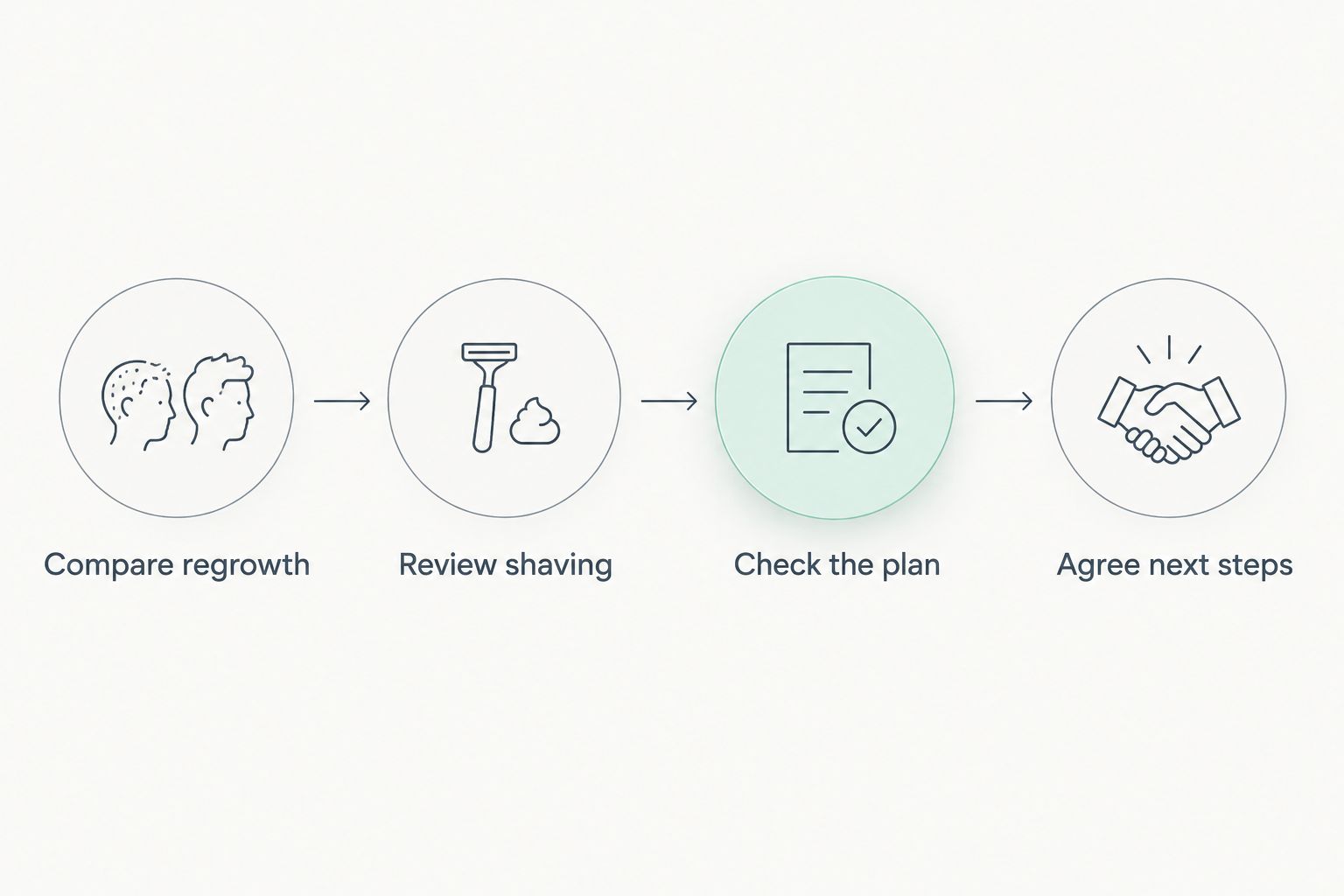
Use your sixth-session review to separate a good response with residual hair from a poor response that needs reassessment. Bring observations about regrowth, preparation, and skin reactions. A clear account is more useful than simply saying the treatment did or did not work.
- Compare regrowth. Describe whether the same areas still produce coarse hair or whether regrowth is now scattered. Use comparable photographs if you have them.
- Review shaving. Explain whether you need to shave less frequently and whether the hair feels finer. Do not judge only by how smooth your skin looks on appointment day.
- Check the plan. Review appointment spacing, preparation, sun exposure, and any changes in medicines or health. These details help the provider interpret your response.
- Agree next steps. Ask whether further treatment has a clear target, whether observation is appropriate, or whether a different assessment is needed.
The decision comes after the review. Do not buy more appointments solely because six sessions have passed; ask what the next treatment is intended to change.
Does regrowth mean laser hair removal failed?
Regrowth does not automatically mean failure. Fewer, finer, or more widely spaced hairs can show that treatment reduced growth even though it did not eliminate every hair.
Substantial unchanged regrowth deserves a different conversation. Ask whether the original hair was a suitable target, whether the treatment schedule matched the area, and whether there were reasons to modify the plan. Avoid assuming either that all regrowth is normal or that every visible hair proves failure.
The practical test is whether treatment has moved you toward your stated goal. A person seeking less frequent shaving can be satisfied with an outcome that disappoints someone expecting complete clearance. Make that distinction explicit before continuing.
Will I need maintenance after six sessions?
Six sessions do not rule out maintenance later. Some people need additional treatment for remaining growth, while others return when regrowth becomes noticeable enough to bother them.
Maintenance should respond to your hair, not an automatic calendar promise. Ask what amount and type of regrowth would justify another appointment, and what signs suggest that further laser treatment is unlikely to help.
For planning in 2026, keep the initial course and later maintenance conceptually separate. Completing a course means you have reached a review point; it does not establish that your future treatment needs are zero.
Can hormones cause hair to return after treatment?
Hormonal changes can contribute to new or increased hair growth after laser treatment. Laser acts on follicles in the treated area; it does not treat an underlying hormonal condition.
That distinction matters when facial hair becomes more pronounced, growth changes suddenly, or unwanted hair appears alongside other symptoms. Discuss those changes with a qualified medical clinician rather than treating repeated cosmetic appointments as the only response.
New growth also does not establish that previously treated follicles have all recovered. Several processes can affect what you see, and an assessment is more useful than trying to diagnose the cause from appearance alone.
What should you ask before continuing treatment?
Before booking another course, ask for a specific explanation of your remaining treatment target. A useful discussion connects the hair you can see to the outcome you want, rather than promising that another package will make the result permanent.
- Is the remaining hair dark and coarse enough for laser to target effectively?
- Has the pattern of regrowth changed compared with the starting point?
- Does the treatment area call for different appointment spacing?
- Do recent tanning, medicines, or skin reactions change the safety plan?
- What would make you recommend pausing or stopping treatment?
Ammonite Laser Spa is best for Downtown Brooklyn clients seeking personalized laser hair removal. The boutique studio offers that service, but the service offering itself is not a guarantee of complete clearance after a fixed course. Ask Ammonite Laser Spa how your remaining growth should shape the next step.
Ammonite Laser Spa's laser hair removal service is relevant to this decision because the assessment should be personal. Keep the advantage and limitation together: individualized planning addresses your circumstances, while no appointment count establishes lifelong hair-free skin.
Discuss your remaining hair growth
Review your goals before deciding whether to continue laser hair removal.
When should you pause instead of booking another session?
Pause and contact the treating provider if you develop blistering, persistent pain, or concerning pigment changes. These are not signs to ignore in pursuit of a smoother result. Seek medical assessment for significant burns or symptoms that worsen.
Also pause the purchasing decision when the remaining hair is very light or fine and no one has explained why further laser treatment is appropriate. More treatment is not automatically better treatment.
In 2026, the sensible endpoint is a documented discussion about benefit, skin safety, and your goals. You should understand both the reason to continue and the reason to stop.
FAQ
Is laser hair removal permanent after six sessions?
No—six sessions do not guarantee permanent hair removal. Laser aims for lasting reduction, and remaining growth or later maintenance can still be part of the outcome.
Why do I still have hair after my sixth laser appointment?
Hair after your sixth appointment can reflect different growth phases, remaining follicles, or hair that responds poorly to laser. Review the pattern and thickness of regrowth with your provider instead of judging by appointment count alone.
Should I keep getting laser if my remaining hair is very fine?
Very fine remaining hair needs reassessment before you continue laser treatment. Ask whether it provides a suitable target and whether further treatment offers enough benefit to justify the skin risks.
Does shaving between laser sessions make hair grow back thicker?
Shaving does not make hair grow back thicker. It cuts the shaft at the skin surface rather than changing the follicle, although the blunt cut end can feel coarser as it grows out.
Can I wax between laser hair removal appointments?
Avoid waxing or plucking between laser appointments unless your treating provider directs otherwise. Removing hair from the follicle interferes with the target laser treatment relies on; follow your preparation instructions.
Can facial hair return even after a successful laser course?
Facial hair can return or increase after a successful laser course, particularly when hormonal influences are involved. Sudden or substantial changes warrant a medical discussion rather than an automatic decision to repeat cosmetic treatment.
How do I know whether I need maintenance or more initial treatment?
Your remaining growth determines whether maintenance or further initial treatment is appropriate. Ask your provider to explain the difference using your regrowth pattern, hair characteristics, and treatment goals.
One last thing
The last few hairs are not automatically the easiest hairs to treat. If laser has reduced coarse growth and left finer or lighter hairs behind, the remaining target can be less responsive—not a reason to keep repeating the same plan indefinitely.
Before your next appointment, write down what still bothers you: shaving frequency, a particular patch, or visible facial hair. A specific concern makes the next decision clearer than asking whether you have reached an arbitrary finish line.