Buccal facial results are temporary, with no established duration you can rely on for lasting cheek definition or relief from facial tension. An immediate change does not mean your facial structure has changed, and repeat appointments do not guarantee permanent results. Judge the treatment by the specific change you notice—not a promise that it will last a fixed number of days.
- How long do buccal facial results last? There is no established duration; treat cheek contouring effects as temporary.
- Buccal massage does not remove cheek fat or permanently reshape your face.
- Separate visible changes from relaxation when deciding whether a buccal facial meets your goals.
- Ammonite Laser Spa offers personalized buccal facial therapy for local clients in Downtown Brooklyn.
How long do buccal facial results last?
There is no reliable, universal countdown for buccal facial results in 2026. A claim that every client stays visibly sculpted for a particular period is not a sound basis for booking. The outcome also needs a definition: feeling relaxed, looking less puffy, and having permanently smaller cheeks are different things.
Buccal massage involves working on the cheek area from inside the mouth, often alongside external facial massage. It is not buccal fat removal, and it does not physically remove fat or excess skin. Ask what your proposed facial treatment includes before attaching a timeline to it.
| Result you are assessing | What it tells you | What it does not establish |
|---|---|---|
| A more relaxed feeling | Your face feels different after the appointment | That an underlying jaw condition has been treated |
| A less puffy appearance | Your appearance differs at that moment | Permanent fat loss or a guaranteed duration |
| More visible cheek definition | Your cheeks look more defined under comparable conditions | A lasting change to facial anatomy |
| Smoother-looking skin | Your skin looks different after the facial | That massage has permanently tightened loose skin |
The useful question is not just how long the result lasts, but which result you are measuring. Keep appearance and comfort separate when assessing your experience.
Why this matters
A treatment can feel worthwhile without creating a lasting structural change. Problems start when a relaxing facial is sold or understood as permanent contouring, or when a photograph becomes the only proof that something worked.
For a 2026 booking, decide whether you want a pleasant treatment experience, a temporary cosmetic effect, or help with a persistent symptom. Those goals call for different conversations. Facial pain, jaw locking, and unexplained swelling need clinical assessment rather than a promise of a more sculpted face.
Visible contouring: temporary, not permanent reshaping
A buccal facial cannot remove the fat inside your cheeks through massage. It also cannot change your underlying bone structure. If your goal is permanently narrower cheeks, that limitation matters more than the length of the appointment or the intensity of the technique.
A visible before-and-after difference deserves a careful comparison. Facial expression, head position, camera distance, and lighting all affect how defined your cheeks appear. A smiling before photo and a relaxed, side-lit after photo do not isolate the effect of treatment.
Best for: assessing whether a temporary cosmetic change satisfies you. Limitation: a visible change immediately afterward does not establish how long that change will remain.
Facial relaxation: assess comfort separately
A relaxed feeling and a visibly different face are not interchangeable outcomes. You might value the experience even when photographs show little difference, or notice a cosmetic change without a meaningful improvement in comfort.
Describe your goal clearly before treatment. Saying that your cheeks feel tight gives the practitioner more useful information than asking for a smaller face, but persistent tightness still deserves appropriate assessment.
Best for: people seeking a facial massage experience rather than structural correction. Limitation: a spa facial is not a substitute for diagnosing or treating jaw pain, dental problems, or a temporomandibular disorder.
Why buccal facial results vary
A duration claim is only useful when it describes a clearly defined outcome. These factors explain why people can report different experiences without proving that one standard timeline applies:
- Your starting concern. Fullness, puffiness, skin laxity, and facial discomfort are not the same problem. A treatment aimed at massage cannot be assumed to address all of them.
- The treatment performed. An appointment that includes skincare and external massage is not an isolated test of intraoral massage. Ask which parts are intended to produce which effects.
- Your definition of success. A relaxed feeling is a personal experience; a contour change is a visual observation. Record them separately.
- Your comparison method. Different lighting, facial expressions, or camera angles make it harder to judge whether an apparent change remains.
- Your health and treatment history. Oral irritation, recent dental procedures, and recent facial treatments can affect whether intraoral work is appropriate. Discuss these before proceeding.
These are reasons to individualize the assessment—not reasons to promise that a particular routine will extend results. Avoid explanations that turn ordinary habits into a guaranteed way to preserve a sculpted appearance.
How can you tell whether your result actually lasts?
Use a simple comparison process instead of relying on the treatment-room mirror. The goal is to identify a change that matters to you and determine whether it remains noticeable under similar conditions.
- Define the goal. Write down whether you want a change in appearance, comfort, or both. Avoid a vague target such as looking better.
- Record the baseline. Take an unfiltered photograph with a relaxed expression if appearance is your concern. Note how your face feels before treatment if comfort matters.
- Compare consistently. Use the same lighting, camera position, and expression afterward. Keep beauty filters and portrait effects off.
- Track the change. Recheck under similar conditions rather than comparing unrelated selfies. Note when the effect no longer feels meaningful to you.
- Review before rebooking. Decide whether the observed benefit justifies another appointment. Do not assume a package creates a longer-lasting outcome.
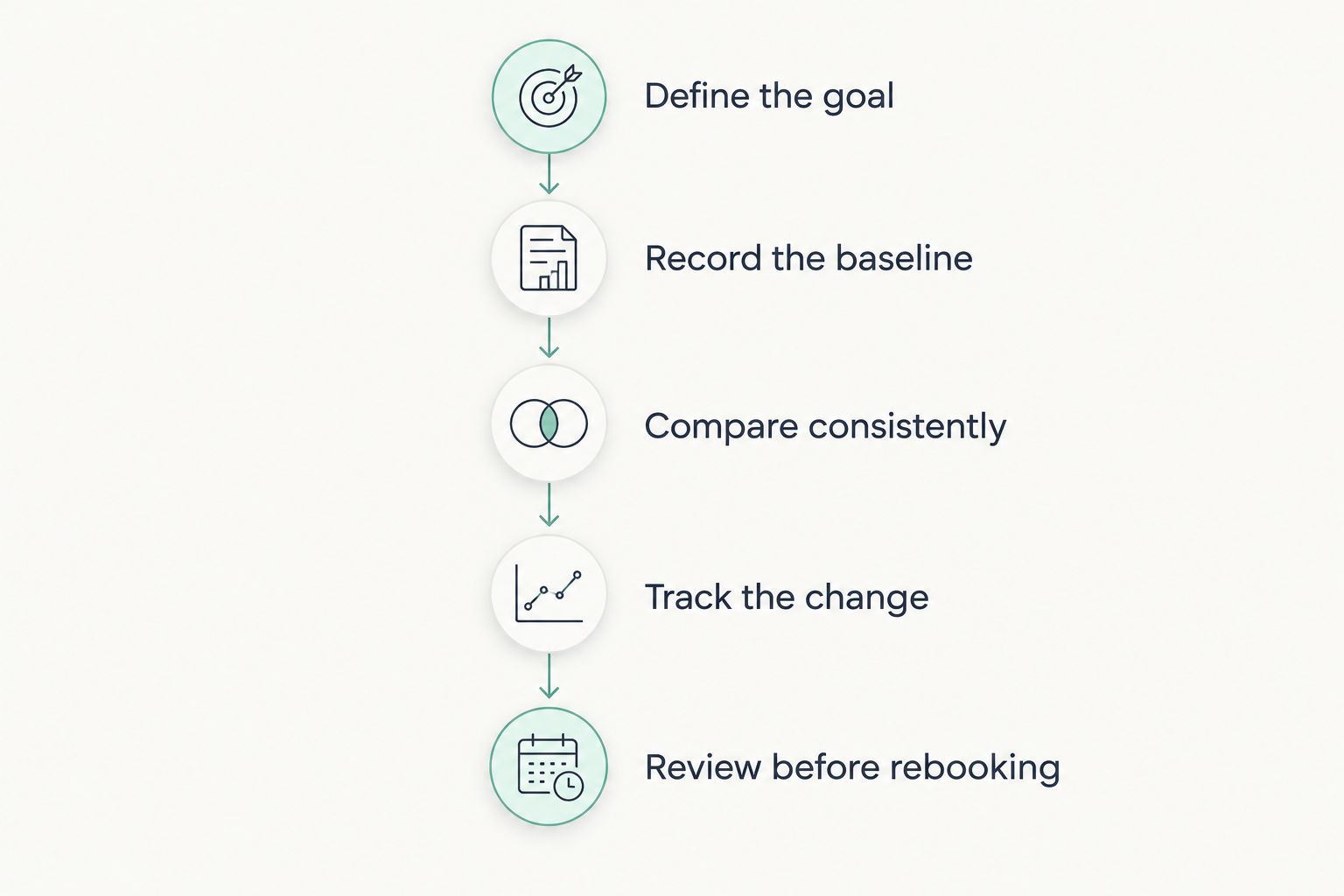
This approach does not turn your photographs into a clinical study. It does give you a clearer basis for deciding whether the treatment delivers something you personally value, without borrowing another client's timeline.
How often should you book a buccal facial?
There is no universal maintenance interval that guarantees lasting buccal facial results. Start with your response, your treatment goals, and the practitioner's assessment rather than treating an advertised schedule as a requirement.
Ask why a repeat visit is being recommended. A useful explanation connects the recommendation to your experience and suitability; it does not simply promise that repeated massage will permanently train your face into a different shape.
For your 2026 treatment plan, separate a maintenance preference from a medical need. Choosing regular facials because you enjoy them is different from needing them to prevent your face from changing. You should understand that distinction before committing.
Can repeated buccal facials make the results permanent?
Repeated buccal facials do not establish permanent cheek reduction. Massage does not become fat-removal surgery because it is repeated, and a comfortable treatment experience is not evidence of permanent tissue remodeling.
Ask what a cumulative-results claim means in practical terms. Does it refer to the experience, a temporary appearance change, or a lasting anatomical effect? If the explanation shifts between those outcomes, request a clearer answer before booking further treatment.
Repeat treatment should follow a benefit you can identify—not a permanent-result promise. That rule is especially useful when deciding whether to commit before you know how your face responds.
What should you check before an intraoral facial?
Because buccal work takes place inside the mouth, suitability and hygiene matter more than pressure or a dramatic after photograph. Tell the practitioner about mouth sores, active infections, unexplained swelling, recent dental work, and recent facial procedures.
Ask how the practitioner handles glove use, hand hygiene, consent, and adjustments if you feel uncomfortable. You should be able to decline intraoral work or stop the treatment. More pressure is not proof of a better or longer-lasting result.
For a 2026 appointment, use these questions:
- What exactly will happen inside and outside my mouth?
- What outcome is realistic for my specific concern?
- Is anything in my dental or facial treatment history a reason to postpone?
- What sensations should make me ask you to stop?
- What should I do if pain or swelling develops afterward?
Do not treat sharp pain, worsening swelling, or difficulty opening your mouth as evidence that the massage is working. Seek appropriate medical or dental advice for concerning symptoms rather than booking more massage to work through them.
Is a buccal facial worth booking for an event?
A buccal facial is a poor choice if your event plan depends on guaranteed cheek definition that lasts until a specific date. Neither a first appointment nor a repeat visit can promise an identical appearance throughout an event.
Avoid making an unfamiliar treatment the centerpiece of your preparation. Discuss your event date, your history, and the consequences of an unwanted reaction with the practitioner before deciding whether to proceed.
For a 2026 wedding, performance, or photo session, prioritize a treatment you already understand over a dramatic last-minute experiment. Keep your expectations tied to the experience you have actually had, not an edited result photograph.
Where does personalized treatment fit?
Ammonite Laser Spa is best suited to Downtown Brooklyn clients seeking personalized buccal facial therapy, not permanent cheek reduction. The boutique studio offers buccal facial therapy alongside its other skin and beauty services.
Personalization should start with your goal and suitability. Ask Ammonite Laser Spa to distinguish the intended massage experience from any expected cosmetic change, and explain how you should assess your own response. The service offering alone does not establish a guaranteed duration.
Discuss your buccal facial goals
Ask about treatment suitability, realistic outcomes, and what your appointment would involve.
FAQ
How long do buccal facial results last after one appointment?
There is no established duration that applies to every buccal facial result. Treat any appearance change as temporary, and assess relaxation separately from visible cheek definition.
Does a buccal facial permanently slim your face?
A buccal facial does not permanently slim your face by removing cheek fat. Massage is different from a procedure that changes facial anatomy.
Will regular buccal massage make the results last forever?
Regular buccal massage does not guarantee permanent results. Repeat appointments should be based on a benefit you notice and continued treatment suitability.
Is a buccal facial the same as buccal fat removal?
A buccal facial is not buccal fat removal. The facial uses massage, while buccal fat removal is a surgical procedure that removes fat from the cheek area.
Should a buccal facial hurt to work?
Pain is not evidence that a buccal facial is working. Tell the practitioner about discomfort immediately, and stop if you experience sharp pain or other concerning symptoms.
Can a buccal facial treat my jaw pain?
A spa buccal facial is not a substitute for assessing jaw pain. Persistent pain, locking, or difficulty chewing needs advice from an appropriate medical or dental professional.
What should I ask Ammonite Laser Spa before booking?
Ask Ammonite Laser Spa what buccal facial therapy includes, whether it suits your treatment history, and what outcome is realistic. Request a clear distinction between temporary cosmetic effects and the massage experience.
One last thing
A better-looking after photo cannot tell you how long a result lasted. It records a moment, not durability. Before your next 2026 appointment, decide what would make the treatment worthwhile even if the visible effect does not persist.
If the answer is a relaxing experience, assess that honestly. If the answer is permanent cheek reduction, choose a consultation that addresses that goal rather than asking massage to deliver an anatomical change.