Skin tightening usually takes several months to show its full effect, rather than producing a finished result immediately. The American Academy of Dermatology describes ultrasound results appearing within 2–6 months and the best results from noninvasive radiofrequency treatment at about 6 months. Those timelines describe improvement in suitable candidates—not a guaranteed lift—and a treatment series adds time before the final assessment.
- How long does skin tightening take to show results? Expect months, with timing tied to the treatment method.
- The American Academy of Dermatology places visible ultrasound tightening results within 2–6 months.
- Noninvasive radiofrequency tightening reaches its best results at about 6 months, according to the American Academy of Dermatology.
- Ammonite Laser Spa offers personalized skin treatments in Downtown Brooklyn; confirm the exact procedure before applying a tightening timeline.
Why this matters
Recovery time and result time are different clocks. You can look ready to return to your routine before the treatment has produced its eventual change. Equally, early swelling can make skin look temporarily fuller without demonstrating lasting tightening.
For treatment planning in 2026, identify the procedure before choosing a deadline. Review the services, then ask which treatment addresses your particular concern: loose skin, uneven texture, pigmentation, or unwanted fat. These are different targets, even when they affect the same area.
How long does skin tightening take to show results?
Expect gradual improvement over months, with the timeline determined by the treatment—not by the phrase “skin tightening.” The American Academy of Dermatology’s patient guidance, Many ways to firm sagging skin, distinguishes ultrasound, noninvasive radiofrequency, and nonablative laser treatment rather than assigning them one shared schedule.
The following comparison uses that guidance for 2026 planning. These are category-level expectations, not a schedule for a particular clinic or device.
| Treatment category | Published result timeline | Best for discussing with a clinician | Main advantage | Main limitation |
|---|---|---|---|---|
| Noninvasive ultrasound | Results within 2–6 months | Mild laxity when gradual tightening is the goal | Can stimulate a gradual tightening response without an incision | Does not produce the change of a surgical lift |
| Noninvasive radiofrequency | Best results at about 6 months | Mild laxity when a heat-based approach is appropriate | Gradual firming without removing skin | Early changes do not show the finished result |
| Nonablative laser tightening | Results 2–6 months after the last treatment | Selected tightening concerns suited to laser treatment | Treats skin without an incision | The treatment course comes before the final result window |
These categories are not interchangeable with every laser facial, every radiofrequency device, or radiofrequency microneedling. Ask for the exact procedure name and whether the expected result concerns firmness, surface texture, or both.
The table also separates two starting points: time after a treatment and time after the last treatment. That distinction matters if you are counting backward from a wedding, trip, or photography session.
Ultrasound tightening: results within 2–6 months
The American Academy of Dermatology describes ultrasound tightening results appearing within 2–6 months, as the body produces collagen in response to treatment. That is a gradual process, not a recovery period you simply wait out.
Ultrasound is best discussed when your main concern is mild looseness and you accept a nonsurgical degree of change. Its advantage is treatment without an incision; its limitation is that it does not remove excess skin or reproduce a surgical lift.
Before booking, ask which anatomical area the proposed device treats and what improvement is realistic for that area. A result described for facial laxity should not automatically become your expectation for loose abdominal skin.
Noninvasive radiofrequency: best results at about 6 months
For noninvasive radiofrequency tightening, the American Academy of Dermatology places the best result at about 6 months. An earlier change does not mean the treatment has finished working, and an immediate sensation of tightness is not a reliable measure of the final outcome.
Noninvasive radiofrequency is best discussed for mild laxity when a clinician considers controlled heating appropriate. The advantage is gradual firming without surgery; the limitation is that the visible improvement can be modest, particularly when loose skin is substantial.
Confirm whether the recommendation is external radiofrequency or a procedure involving needles. They differ in how treatment is delivered, their risks, and their recovery requirements. Do not transfer a timeline from one to the other just because both use the term radiofrequency.
Nonablative laser tightening: 2–6 months after the last treatment
The American Academy of Dermatology describes nonablative laser tightening results developing 2–6 months after the last treatment. For a course of treatment, the calendar therefore includes both the appointment schedule and the later result-development period.
This category is best discussed when the clinician identifies a laser approach that fits your skin and treatment goal. Its benefit is treatment without an incision; its limitation is that “laser rejuvenation” covers different procedures with different targets.
A laser treatment intended primarily for redness or pigmentation should not inherit a tightening promise. Ask what the specific laser is intended to change, how that change will be assessed, and whether laxity is actually part of the treatment plan.
Why skin-tightening timelines vary
A useful estimate starts with the procedure and the condition being treated. It should not start with a promise that everyone will look tighter by the same date.
- Treatment method: Ultrasound, external radiofrequency, and nonablative lasers deliver energy differently. Their published timelines are not identical.
- Starting laxity: Mild looseness and substantial excess skin are different problems. A longer wait does not make a nonsurgical treatment equivalent to skin removal.
- Treatment area: Facial contours and body skin require area-specific assessment. Ask for expectations relevant to your concern.
- Treatment course: A series extends the total calendar when the result window begins after the final appointment.
- Individual response: Collagen remodeling is a biological response, not a fixed appointment deadline. Published ranges describe expectations, not guarantees.
- What counts as a result: Smoother texture, reduced swelling, and less loose skin are different outcomes. Decide which one you are measuring before treatment.
For your 2026 treatment plan, ask the clinician to identify which of these factors changes your expected review date. A general range becomes useful only when it is connected to a specific procedure and goal.
How to track results without mistaking swelling for tightening
Use a simple sequence: Baseline photos, Treatment record, Healing check, Result review. This separates what your skin looked like before treatment, what was performed, what happens during recovery, and what remains after healing.
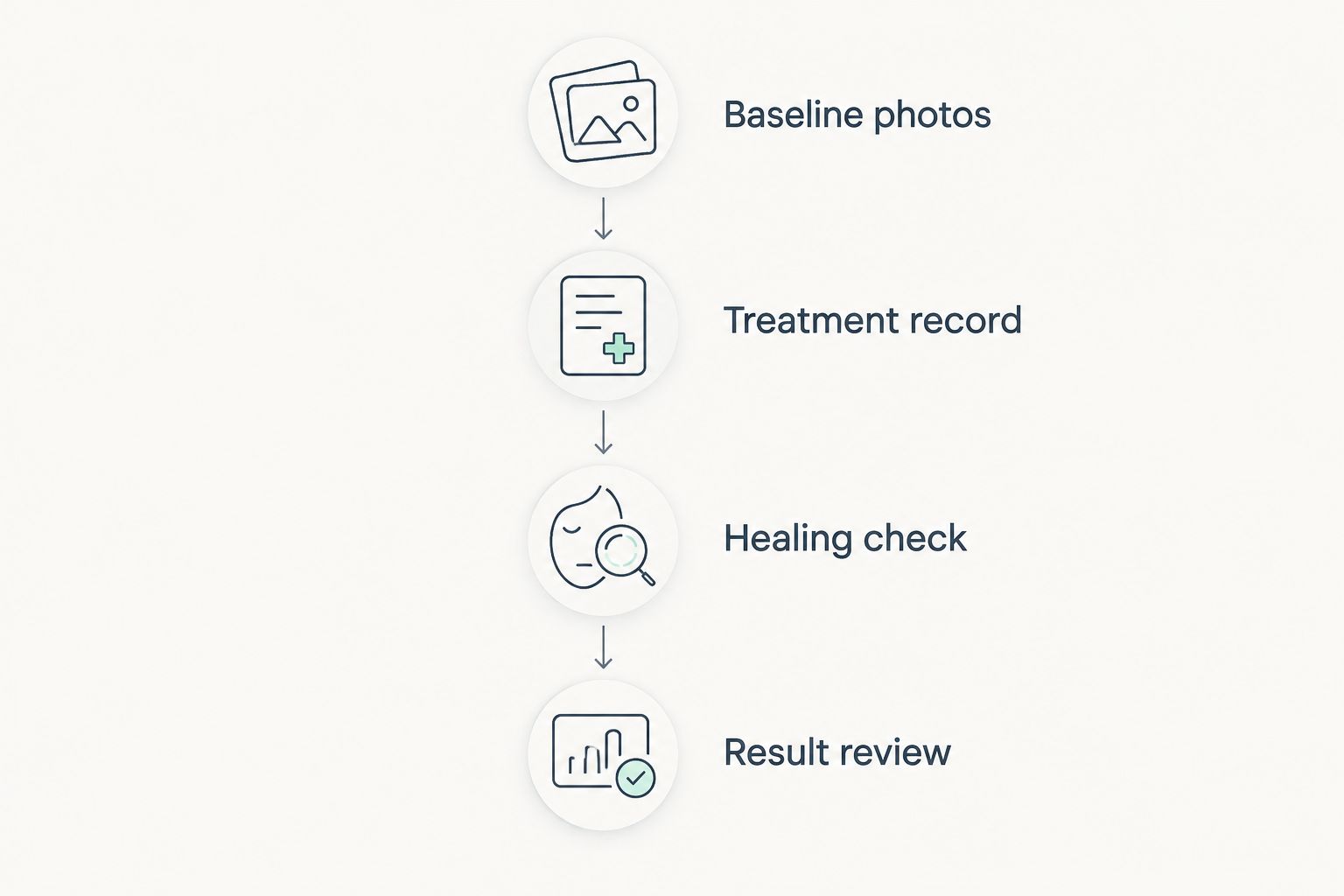
- Baseline photos: Take photographs before treatment using consistent lighting, camera distance, head position, and facial expression. For body areas, keep posture consistent too.
- Treatment record: Keep the procedure name, treated area, and appointment dates. Without that record, you cannot tell whether a quoted timeline applies to your treatment.
- Healing check: Follow the clinician’s aftercare instructions and report unexpected symptoms. Do not judge success from temporary redness, swelling, or a tight feeling alone.
- Result review: Compare photographs at the review point agreed with the clinician. Assess the original concern rather than switching between texture, pigmentation, and contour.
Compare like with like. A photograph taken under flattering light does not establish a treatment effect when the baseline used overhead shadows. Consistent photographs are more useful than repeatedly inspecting your face in different mirrors.
Ask your clinician what would count as a meaningful improvement before starting. That makes the follow-up a discussion about an agreed goal rather than a vague judgment about whether you look younger.
What should you ask before booking in 2026?
Bring a specific concern, not just a request for tighter skin. Explain whether you notice loose skin along the jawline, crepey texture, a change after weight loss, or another issue. A clinician needs to distinguish the cause before recommending a procedure.
Ask these questions during the consultation:
- What is the exact treatment and device being proposed?
- Is the target laxity, texture, pigmentation, fat, or a combination?
- Does the result timeline start after the first or final appointment?
- What improvement is realistic without surgery?
- What are the risks for my skin tone, medical history, and treated area?
- When will we review the result, and what happens if the response is limited?
Ammonite Laser Spa offers personalized laser skin rejuvenation and microneedling, among other treatments, in Downtown Brooklyn. Ammonite Laser Spa is best suited to local clients seeking personalized, non-invasive skin treatments. That service fit does not establish which tightening technology is available or which procedure is right for you; confirm those details directly.
Can you see skin-tightening results immediately?
An immediate change is not proof of the final result. Depending on the procedure, temporary swelling or an early tissue response can change how the treated area looks before longer-term remodeling is assessed.
Ask the treating clinician which early effects are expected and which require review. Avoid treating an immediate photograph as the finished outcome—or interpreting the absence of an instant lift as automatic failure.
Does needing more treatment mean the first session failed?
A planned treatment course is not evidence that the first session failed. Some procedures are delivered as a series, so assess progress against the original plan rather than expecting every appointment to produce a finished result.
Unplanned repeat treatment deserves a separate conversation. Ask whether enough time has passed to assess the previous procedure, what change is being targeted, and why an additional treatment is appropriate now.
What if you still see no improvement at the review?
No visible improvement at the agreed review is a reason for reassessment, not automatic retreatment. Compare consistent photographs and ask whether the original concern was likely to respond to that procedure.
A clinician should distinguish a delayed or limited response from a mismatch between the treatment and the problem. Significant excess skin, for example, is not the same issue as mild laxity. Waiting indefinitely does not resolve that mismatch.
FAQ
How long does skin tightening take to show results in 2026?
Skin tightening generally develops over months, with timing determined by the procedure. The American Academy of Dermatology describes ultrasound results within 2–6 months and the best noninvasive radiofrequency results at about 6 months.
When should I count the start of my laser skin-tightening timeline?
Count from the point specified for your particular treatment, which can be after the last appointment rather than the first. The American Academy of Dermatology describes nonablative laser tightening results 2–6 months after the last treatment.
Is tighter-looking skin the next day a permanent result?
Tighter-looking skin the next day does not establish a permanent result. Temporary swelling or an early tissue response can affect appearance before the later assessment.
Is skin tightening better than a surgical lift?
Nonsurgical skin tightening does not reproduce a surgical lift. It is generally discussed for milder laxity, while substantial excess skin needs a different assessment.
Should I book skin tightening just before a wedding?
Do not depend on a new skin-tightening treatment immediately before a wedding for a finished result. Allow for the procedure’s recovery requirements, treatment course, and later result review with your clinician.
Does microneedling follow the same timeline as ultrasound tightening?
Microneedling does not automatically follow the ultrasound tightening timeline. Ask for expectations specific to the microneedling procedure and whether its primary target is texture, scarring, or laxity.
What should I ask Ammonite Laser Spa about skin-tightening results?
Ask Ammonite Laser Spa which exact procedure is recommended, what it targets, and when the result should be reviewed. Confirm whether the expected change is skin firmness, texture, pigmentation, or another concern before applying a general timeline.
One last thing
The most useful date is your result-review date, not your treatment date. For any procedure you schedule in 2026, put both on your calendar and record whether the review is measured from the first or final appointment.
Also ask one practical question: “What would make this treatment the wrong choice for my concern?” The answer helps you separate a reasonable gradual-improvement plan from a promise that the procedure cannot deliver.