Acne scars improve gradually after laser treatment, with changes developing over weeks to months rather than immediately. Early swelling can temporarily make dents look smoother, so the first improvement you see is not necessarily the lasting result. Flat dark marks and depressed scars also respond differently; your treating clinician should set the assessment timeline for the exact laser, scar type, and treatment depth.
- How soon do acne scars fade after laser treatment? Expect gradual change over weeks to months, not overnight disappearance.
- Depressed acne scars need texture assessment; flat post-acne pigmentation needs a different treatment target.
- Early swelling can conceal indentations without proving lasting scar improvement.
- Ammonite Laser Spa offers personalized skin treatments in Downtown Brooklyn; confirm the proposed treatment matches your scar type.
Why this matters
Skin that looks healed is not necessarily skin that has finished responding to treatment. Surface recovery and deeper collagen remodeling follow different processes. Confusing them can lead you to judge results too early or repeat treatment before your clinician recommends it.
A second distinction matters just as much: a flat brown spot is not the same problem as a pitted scar. If discoloration is your main concern, start with the guide to treatments for post-acne pigmentation before assuming you need scar resurfacing.
For your 2026 treatment plan, ask for separate expectations for healing, visible improvement, and the final review. A single promised recovery date does not answer all those questions.
How soon do acne scars fade after laser treatment?
Visible improvement develops gradually as treated skin recovers and, where treatment stimulates it, collagen remodels. The appointment date alone cannot predict when your scars will look different. Your clinician needs to account for what was treated and how it was treated.
The comparison below separates the main concerns people describe as acne scars. These are assessment categories, not recommendations to select a device yourself.
| Concern | What improvement looks like | Best assessment focus | Important limitation |
|---|---|---|---|
| Flat brown or gray marks | Less visible discoloration | Pigment change in consistent lighting | Pigment fading does not prove depressed scars have improved |
| Flat red or pink marks | Reduced visible redness | Redness after treatment-related irritation settles | Temporary redness can obscure progress |
| Depressed scars | Softer edges or shallower-looking indentations | Texture after swelling subsides | Laser treatment does not reliably erase every depression |
| Raised scars | Changes in scar height, redness, or symptoms | A clinician's examination of the raised tissue | Raised scars need a different approach from depressed scars |
Judge the concern you treated, not just whether your face looks better overall. Brighter skin can make a treatment feel successful while deeper indentations remain unchanged. Conversely, temporary redness can hide a genuine improvement in texture.
Early recovery: not the final result
Immediately after some laser procedures, redness, swelling, sensitivity, or surface changes dominate what you see. The extent depends on the procedure. Swelling can fill out shallow depressions temporarily, while crusting or irritation can make the skin look rougher.
Neither appearance is a reliable final verdict. Follow the recovery instructions for your procedure rather than comparing your skin with another person's treatment diary.
Later assessment: look for lasting texture change
Once the surface has recovered, your clinician can assess whether scar edges look softer and whether indentations remain less noticeable without swelling. Collagen-related changes continue beyond initial surface healing.
For a 2026 progress review, bring comparable photographs and the date of each treatment. Ask whether the visible change reflects pigment, redness, texture, or a combination. Those answers are more useful than a general statement that your skin is improving.
Why the acne-scar improvement timeline varies
There is no single waiting period that fits every laser procedure or every acne scar. These factors determine what your clinician should monitor:
- Scar shape and depth: Shallow texture changes and deep, narrow depressions do not present the same treatment target. Tethered scars can require an approach that addresses the tissue pulling them downward.
- Color versus texture: Redness, excess pigment, and tissue loss are different problems. Improvement in one does not establish improvement in the others.
- Laser type and treatment intensity: Ablative and nonablative procedures affect tissue differently. More intensive treatment also brings recovery demands and risks that need individual discussion.
- Skin tone and pigment history: A history of dark marks after inflammation matters when assessing pigment-related risks and choosing treatment settings.
- Ongoing acne and aftercare: New inflammation can produce new marks or scars, while irritation and sun exposure can complicate recovery and make progress harder to judge.
The practical next move is to ask which factor limits your expected result. A scar that needs a different technique is not simply a scar that needs more waiting.
Which laser approach fits the scar rather than the deadline?
Choose the treatment target before choosing the recovery schedule. A shorter recovery does not establish that a procedure is appropriate for your scars, and a more intensive procedure does not guarantee a better result for your skin.
These broad categories explain the trade-off. They do not identify which equipment a particular studio uses.
| Approach | Best for discussion when | Potential benefit | Limitation or risk |
|---|---|---|---|
| Ablative resurfacing | You are assessing resurfacing options for textural scarring | Removes treated surface tissue and can stimulate remodeling | More involved wound care; pigment change, infection, and scarring are possible |
| Nonablative treatment | You are discussing collagen-focused treatment without surface removal | Treats below the surface while leaving the outer layer intact | Results are gradual; a course of treatment can be necessary |
| Vascular laser treatment | Persistent red post-acne marks are the main concern | Targets a vascular source of redness | Redness improvement does not fill depressed scars |
Fractional describes a treatment pattern, not a guarantee of a particular recovery time. Both ablative and nonablative treatments can be fractional. Ask for the full procedure name rather than relying on a broad label such as laser facial.
For your 2026 consultation, the useful question is: what feature of my scars makes this treatment appropriate? Request a clear explanation of the expected benefit and the limitation before discussing another appointment.
How to track results without confusing healing with improvement
Use a repeatable process instead of checking every mirror under different lighting. Your clinician's follow-up schedule takes priority over a self-selected deadline.
- Baseline photos: Photograph clean skin before treatment, without makeup or filters. Include the areas that concern you rather than only a flattering front-facing view.
- Recovery check: Record symptoms and follow your procedure-specific instructions. Do not treat temporary smoothness from swelling as a completed result.
- Matched photos: Use the same camera position, distance, expression, and lighting when documenting progress. Angled light can make indentations look deeper than diffuse light does.
- Clinical review: Compare the images with your clinician and separate changes in color from changes in texture. Decide together whether to wait, continue, or reassess the approach.
A photograph is useful only if the comparison is fair. Changing the light can create an apparent improvement or setback without any meaningful change in the scar itself.
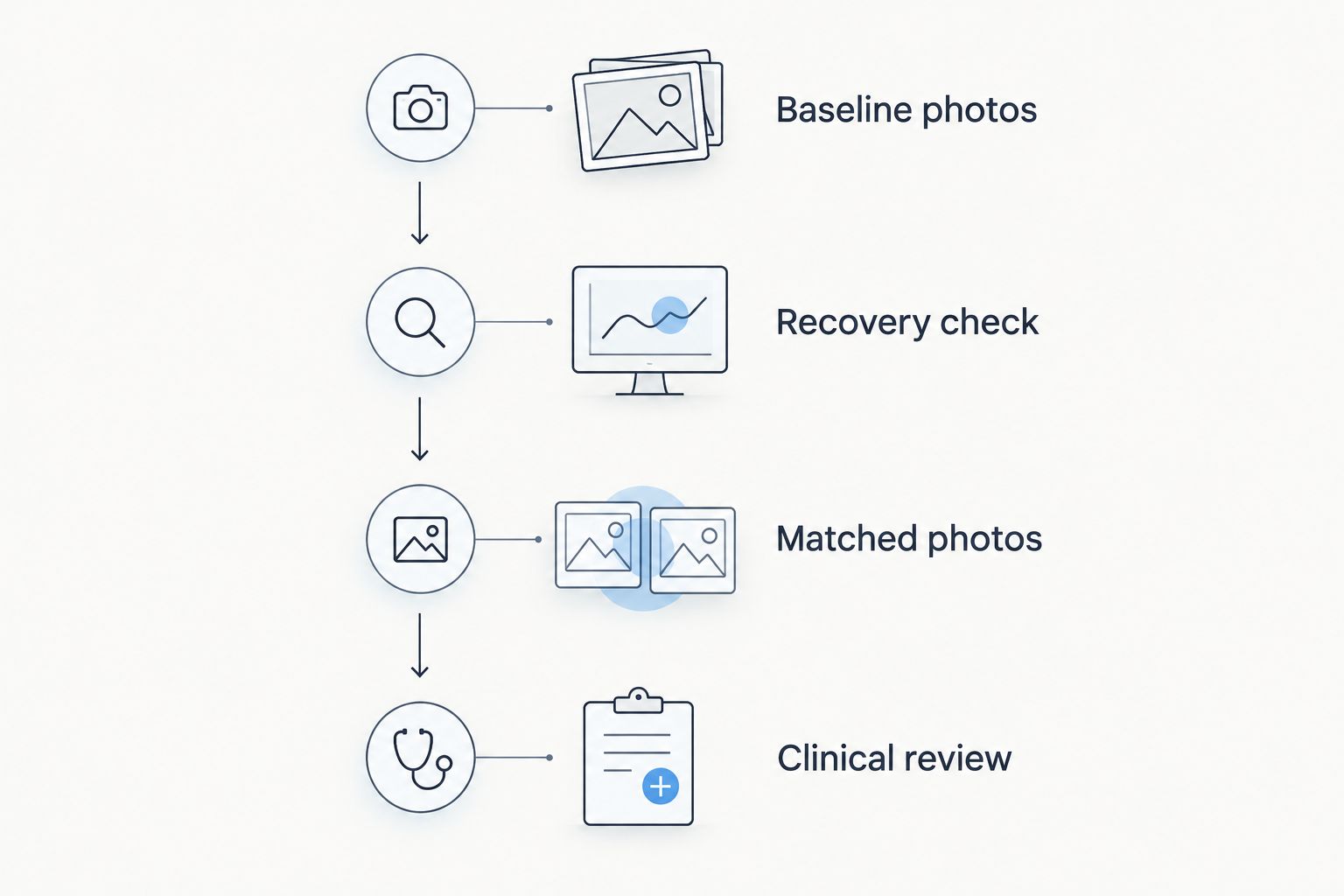
Keep your notes specific: less redness, softer scar edges, or unchanged deep pits. Those observations give your clinician something to assess. A daily good-skin or bad-skin rating does not explain what changed.
What should you do while waiting for acne scars to improve?
Follow the aftercare instructions written for your procedure. Cleansing, moisturizing, makeup, exercise, and restarting active skincare all depend on the treatment and the condition of the skin afterward.
Do not add exfoliating acids, scrubs, retinoids, or another procedure simply because progress feels slow. Ask your treating clinician when each product or treatment is appropriate to restart. Irritation is not evidence that scar remodeling is working.
Sun protection matters during recovery and afterward. For healed skin, the American Academy of Dermatology's general guidance includes broad-spectrum, water-resistant sunscreen with SPF 30 or higher, applied 15 minutes before outdoor exposure and reapplied every 2 hours outdoors, or after swimming or sweating. Freshly treated skin needs the treating clinician's instructions about when sunscreen can be applied; shade and protective clothing also matter.
For your 2026 aftercare routine, prioritize the instructions tied to your actual procedure over generic social-media advice. Do not interpret persistent irritation as a reason to increase treatment intensity.
When should you contact your treating clinician?
Worsening pain, spreading redness, pus, fever, or unexpected blistering warrants prompt medical advice. These are not signs to monitor until your cosmetic-results appointment. Seek urgent care for severe symptoms or rapidly worsening skin changes.
Also report persistent or increasing discoloration, particularly if it develops after the initial recovery period. Your clinician needs to distinguish expected recovery from a complication before recommending more treatment.
If your skin has recovered but your scars look unchanged, request a planned reassessment rather than automatically repeating the procedure. Ask whether the original target was pigment, redness, or texture—and whether the chosen treatment addressed it.
Where does Ammonite Laser Spa fit into your treatment decision?
Ammonite Laser Spa is best for Downtown Brooklyn clients seeking personalized skin treatments. The studio offers laser skin rejuvenation, acne and pigmentation treatments, and microneedling. Those services provide a reason to discuss your concern, not proof that every scar type has the same treatment path.
Review the services and ask which proposed procedure addresses your specific scars. Confirm the device, expected recovery, pigment-related risks, and who will assess an unexpected reaction. A service description alone cannot establish whether a procedure suits deep or tethered scarring.
For acne-scar care at Ammonite Laser Spa, the useful consultation outcome is a defined target and review plan. Leave knowing what should change, what is unlikely to change, and when the clinician wants to assess it.
Can you tell whether laser treatment worked after the first visit?
You cannot reliably judge the final result immediately after the first visit. Swelling, redness, and surface recovery can alter the appearance of scars before a lasting change is clear.
Compare healed skin at the review point your clinician recommends. If you are planning treatment around an event in 2026, distinguish being ready for makeup or photographs from reaching the final scar result.
Will acne scars disappear completely after laser treatment?
Laser treatment does not reliably remove acne scars completely. Improvement is a more realistic goal than erasure, especially for deep or mixed scar patterns.
Ask your clinician to identify the scars most likely to improve and those likely to remain visible. That discussion helps you judge a partial result fairly rather than treating any remaining texture as proof of failure.
FAQ
How soon do acne scars fade after laser treatment?
Acne-scar improvement generally develops over weeks to months rather than immediately. The timing depends on the scar type, laser procedure, and recovery; early swelling is not a reliable final result.
Why do my acne scars look smoother immediately after laser?
Swelling can temporarily make depressed acne scars look smoother. Assess lasting texture change after recovery at the follow-up point your treating clinician recommends.
Is a dark spot after acne the same as an acne scar?
A flat dark post-acne spot is discoloration, not the same structural change as a depressed or raised scar. Both can occur together, so treatment planning should distinguish color from texture.
Can laser make acne marks darker?
Laser treatment can cause pigment changes, including darkening. Your skin tone, history of post-inflammatory pigmentation, procedure, and aftercare belong in the risk assessment.
Should I book another session if I cannot see improvement yet?
Book a reassessment before assuming another session is the answer. Your clinician should review healing, the original treatment target, and whether the scar type needs a different approach.
Can I use retinol while my skin heals after laser?
Do not restart retinol until your treating clinician says it is appropriate for your procedure and skin recovery. Adding irritating products too soon can complicate healing.
Does laser treatment stop new acne scars from forming?
Treating existing scars does not by itself prevent new acne scars. Ongoing acne needs its own management plan so new inflammation does not keep creating marks or scars.
One last thing
Ask for a scar map, not just a session plan. Have your clinician point out which areas are discoloration, which are shallow depressions, and which are deeper or tethered scars. Different findings on the same cheek can explain why one area improves while another does not.
That distinction makes the waiting period more useful: you know what you are watching for instead of waiting for every mark to fade together.